02/02/2021
Let $ABC$ be a triangle with $AB=13, BC=14, AC=15$. Let $H, I, M$ be the orthocenter of $▵{ABC}$, incenter of $▵{ABC}$, and midpoint of $BC$, respectively. What is the area of $▵{HIM}$?
Solve:
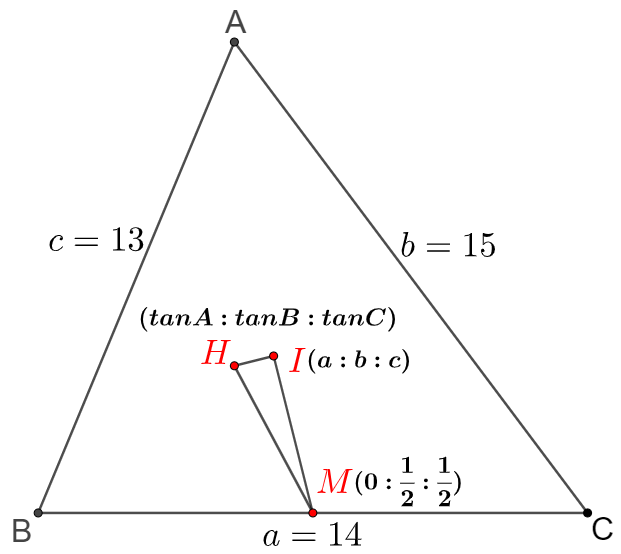
MATLAB code
syms a b c
fc = a^2 + b^2 - c^2;
fb = a^2 + c^2 - b^2;
fa = b^2 + c^2 - a^2;
f = fa*fb + fb*fc + fc*fa;
s = a + b + c;
S = sqrt(s/2 * (s/2 - a) * (s/2 - b) * (s/2 - c));
SValue = subs(S);
A = [0 1/2 1/2; a/s b/s c/s; fb*fc/f fa*fc/f fa*fb/f];
B = det(A, 'Algorithm', 'minor-expansion');
pretty(B)
a = 14; b = 15; c = 13;
subs(B)
subs(B * SValue)
Result:
B = -(- a^3*b + a^3*c - a^2*b^2 + a^2*c^2 + a*b^3 + a*b^2*c - a*b*c^2 - a*c^3 + b^4 - 2*b^3*c + 2*b*c^3 - c^4)/(2*(a^4 - 2*a^2*b^2 - 2*a^2*c^2 + b^4 - 2*b^2*c^2 + c^4))
     3      3      2  2    2  2      3      2          2      3    4      3          3    4
  - a  b + a  c - a  b  + a  c  + a b  + a b  c - a b c  - a c  + b  - 2 b  c + 2 b c  - c
- -----------------------------------------------------------------------------------------
                          4      2  2      2  2    4      2  2    4
                        (a  - 2 a  b  - 2 a  c  + b  - 2 b  c  + c ) 2
ans =
17/672
ans =
17/8
References:
- Barycentric Coordinates in Olympiad Geometry - Evan Chen
- Barycentric Coordinates for the impatient - Evan Chen
- Barycentric Coordinates
- Introduction to the Geometry of the Triangle
02/04/2021
Let $A=\frac{2}{3} \cdot \frac{5}{6} \cdot \frac{8}{9} \cdots \cdot \frac{995}{996} \cdot \frac{998}{999}$. Which is bigger, $A$ or $0.1?$
02/08/2021
Frieda the frog begins a sequence of hops on a 3×3 grid of squares, moving one square on each hop and choosing at random the direction of each hop-up, down, left, or right. She does not hop diagonally. When the direction of a hop would take Frieda off the grid, she “wraps around” and jumps to the opposite edge. For example if Frieda begins in the center square and makes two hops “up”, the first hop would place her in the top row middle square, and the second hop would cause Frieda to jump to the opposite edge, landing in the bottom row middle square. Suppose Frieda starts from the center square, makes at most four hops at random, and stops hopping if she lands on a corner square. What is the probability that she reaches a corner square on one of the four hops? (AMC 10A 2021 Problem 23)
Solution 1:
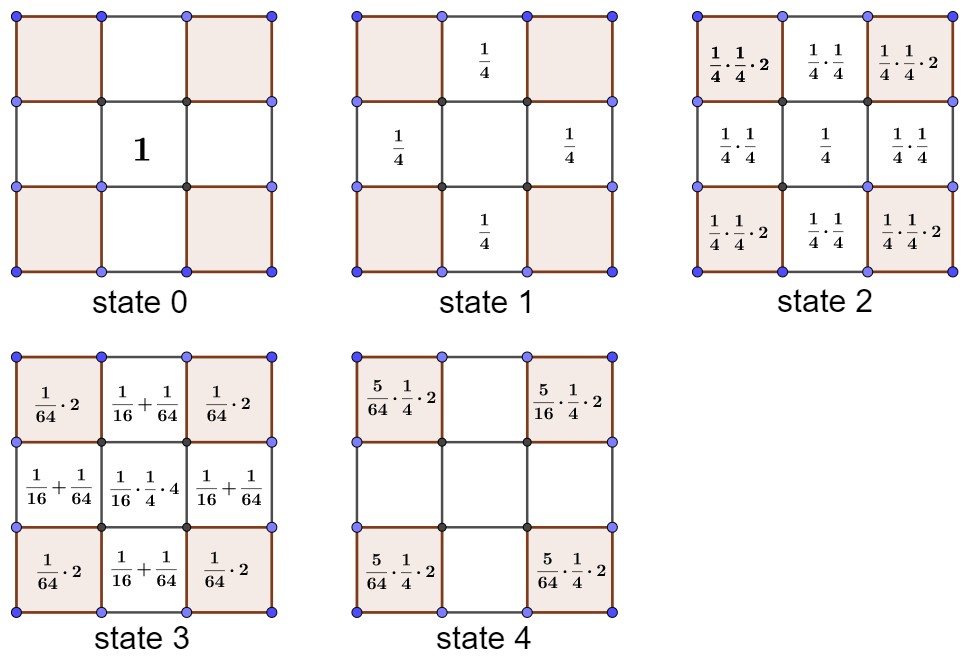
So we know that the probability that she reaches a corner square on one of the four hops is:
$\dfrac{1}{4} \cdot \dfrac{1}{4} \cdot 2 \cdot 4 + \dfrac{1}{32} \cdot 4 + \dfrac{5}{64} \cdot \dfrac{1}{4} \cdot 2 \cdot 4 = \bbox[5px, border: 1px solid black]{\dfrac{25}{32}}$
Solution 2:
The transfer matrix for hops: \(\begin{align*} A= \begin{bmatrix} 0 & 1 & 0\\ \dfrac{1}{4} & \dfrac{1}{4} & \dfrac{1}{2}\\ 0 & 0 & 0 \end{bmatrix} \end{align*}\) Explanation: there are three kinds of grids: first the center, then the side, last the corner. The probability from center to center is 0, and from center to side grids is 1, and from center to corner is 0. The probability from side to center is $\dfrac{1}{4}$, from side to side on the opposite edge is $\dfrac{1}{4}$, and from side to corner is $\dfrac{1}{2}$ since there are two ways to hop to corner from side. The probability from corner to any grid is 0, so the third row is all zero.
The transfer matrix after each hop is \(\begin{align*} A^2 = \begin{bmatrix} \dfrac{1}{4} & \dfrac{1}{4} & \dfrac{1}{2} \\ \dfrac{1}{16} & \dfrac{5}{16} & \dfrac{1}{8}\\0 & 0 & 0 \end{bmatrix}, A^3 = \begin{bmatrix}\dfrac{1}{16} & \dfrac{5}{16} & \dfrac{1}{8} \\ \dfrac{5}{64} & \dfrac{9}{64} & \dfrac{5}{32}\\0 & 0 & 0 \end{bmatrix}, A^4 = \begin{bmatrix}\dfrac{5}{64} & \dfrac{9}{64} & \dfrac{5}{32} \\ \dfrac{9}{256} & \dfrac{29}{256} & \dfrac{9}{128}\\0 & 0 & 0 \end{bmatrix} \end{align*}\)
The required result is to sum all probabilities to corner grids from each hop $A$, $A^2$, $A^3$ and $A^4$. \(\begin{align*} \begin{bmatrix}1 & 0 & 0\end{bmatrix} \cdot (A + A^2 + A^3 + A^4 ) \cdot \begin{bmatrix} 1 \\ 0 \\ 0 \end{bmatrix} =\dfrac{1}{2} + \dfrac{1}{8} + \dfrac{5}{32} = \bbox[5px, border: 1px solid black]{\dfrac{25}{32}} \end{align*}\)
02/09/2021
In how many ways can the sequence 1, 2, 3, 4, 5 be rearranged so that no three consecutive terms are increasing and no three consecutive terms are decreasing? (AMC 10A 2021 Problem 20)
Solution:
02/15/2021
Suppose for all $x, y \in \mathbb{R}$ we have $f(x+y)=f(x)+f(y)+xy$ and $f(4)=10$, find $f(2001)$ (2001 Dutch Math Olympiad)
Solution 1:
$f(4)=f(2)+f(2)+4=10 \implies f(2)=3$
$f(2)=f(1)+f(1)+1=3 \implies f(1)=1$
$f(8)=f(4)+f(4)+16=36$
$f(3)=f(1)+f(2)+2=6$
$f(5)=f(2)+f(3)+6=15$
Now we can see that $f(n)=\dfrac{n(n+1)}{2}$ for $n \in \mathbb{N}$ and this is easy to be proved since
$f(n+1)=f(1)+f(n)+n=\dfrac{n(n+1)}{2}+n+1=\dfrac{(n+1)(n+2)}{2}$
So it’s easy to know that $f(2001)=\dfrac{2001 \times 2002}{2}=\bbox[5px, border: 1px solid black]{2003001}$
Solution 2:
We have $f(n+1)=f(n)+f(1)+n \implies f(n+1)-f(n)=n+f(1) $
$\implies f(2001)-f(0)=\displaystyle\sum_{i=0}^{2000}{i} + 2001f(1) \implies f(2001)=\dfrac{2000 \times 2001}{2} + 2001 = \dfrac{2001 \times 2002}{2}=\bbox[5px, border: 1px solid black]{2003001}$
02/21/2021
Two distinct regular tetrahedra have all their vertices among the vertices of the same unit cube. What is the volume of the region formed by the intersection of the tetrahedra? (AMC 10 2011 A problem 24)
Solve:
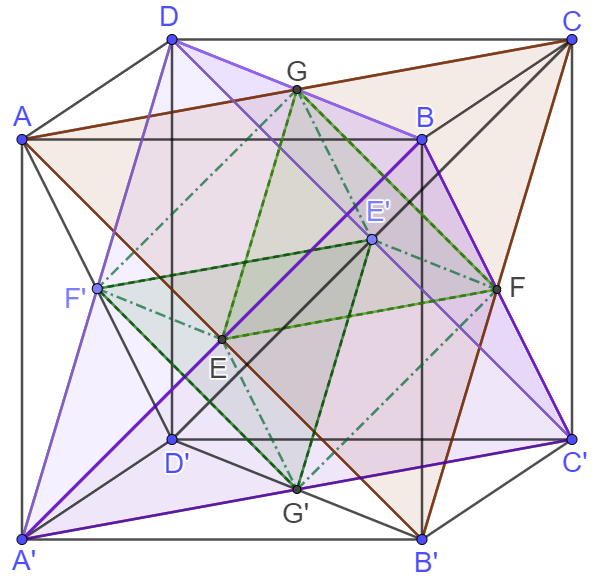
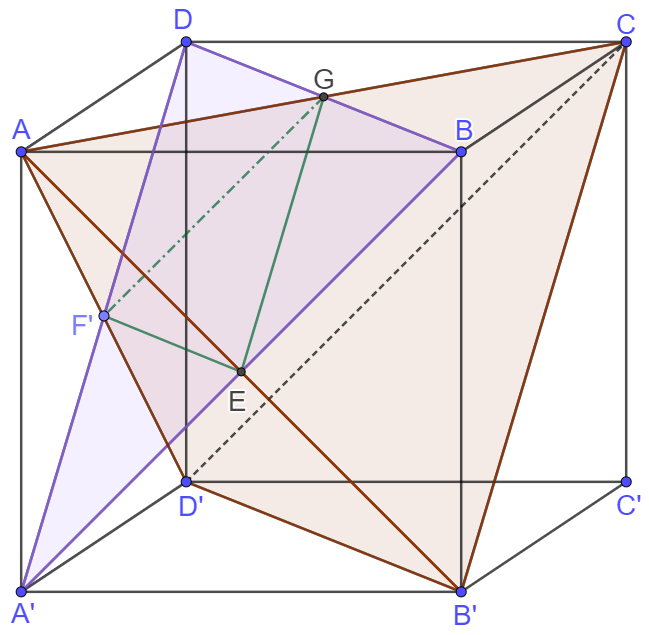
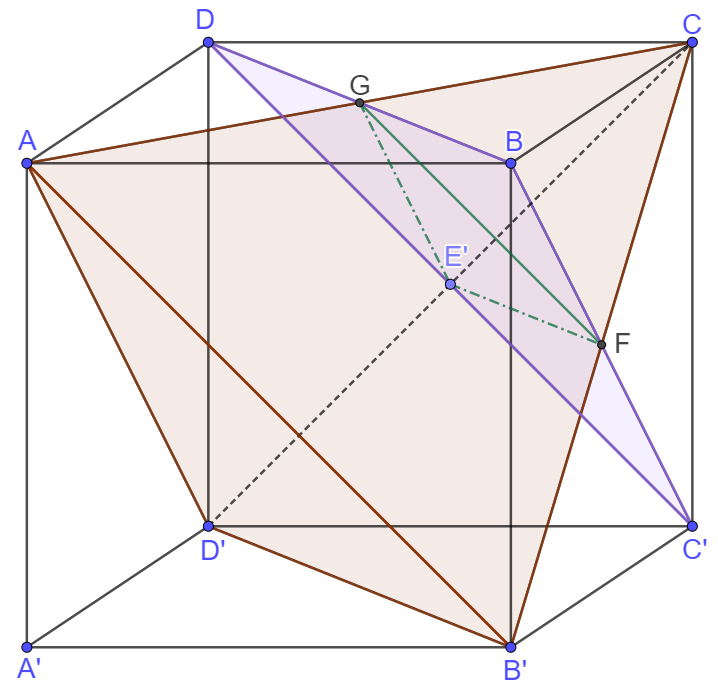
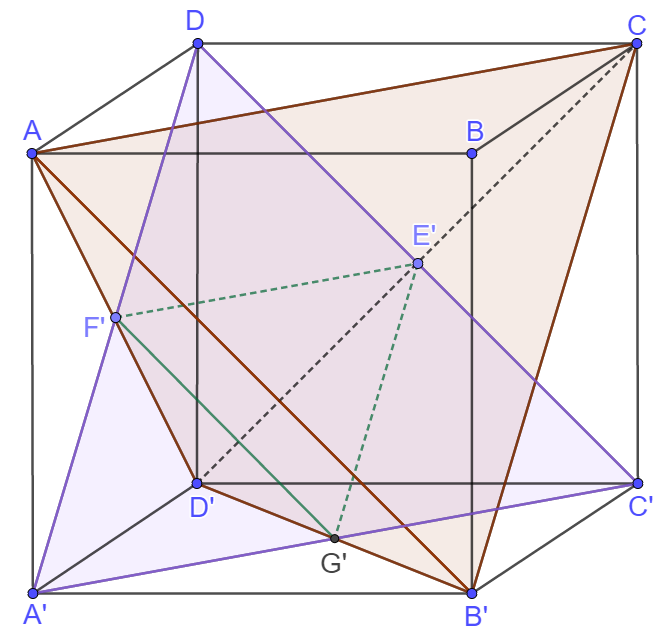
The tetrahedron $A’C’DB$ has faces $A’BC’$, $A’BD$, $BC’D$ and $A’C’D$
The tetrahedron $AB’CD’$ has faces $AB’D’$,$ACD’$, $B’CD’$ and $AB’C$
and here are their insect segments:
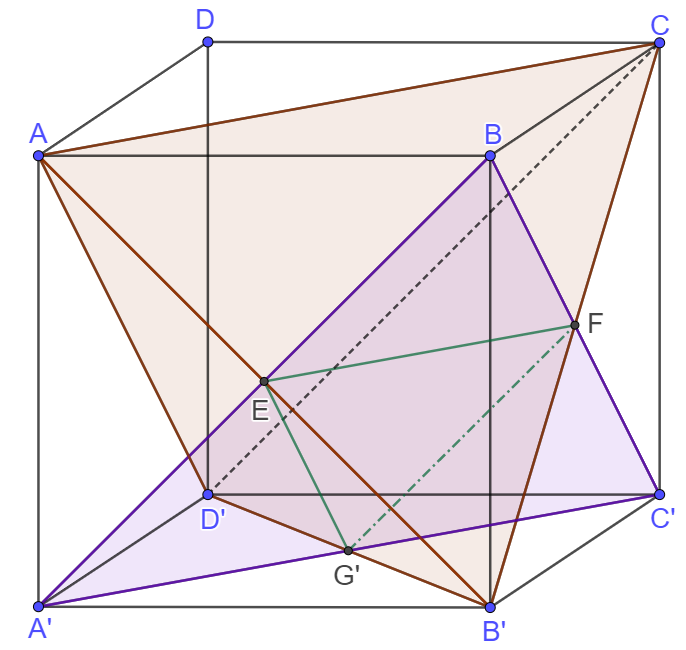
- $A’BC’$ intersects $B’CD’$ at $FG’$, intersects $AB’D’$ at $EG’$, intersects $AB’C$ at $EF$, and does not intersect $ACD’$
-
$A’BD$ intersects $ACD’$ at $F’G$, intersects $AB’D’$ at $EF’$, intersects $AB’C$ at $EG$, and does not intersect $B’CD’$
-
$BC’D$ intersects $ACD’$ at $E’G$, intersects $B’CD’$ at $E’F$, intersects $AB’C$ at $FG$, and does not intersect $AB’D’$
-
$A’C’D$ intersects $ACD’$ at $E’F’$, intersects $B’CD’$ at $E’G’$, intersects $AB’D’$ at $F’G’$, and does not intersect $AB’C$:
| $ACD’$ | $B’CD’$ | $AB’D’$ | $AB’C$ | |
|---|---|---|---|---|
| $A’BC’$ | N/A | $FG’$ | $EG’$ | $EF$ |
| $A’BD$ | $F’G$ | N/A | $EF’$ | $EG$ |
| $BC’D$ | $E’G$ | $E’F$ | N/A | $FG$ |
| $A’C’D$ | $E’F’$ | $E’G’$ | $F’G’$ | N/A |
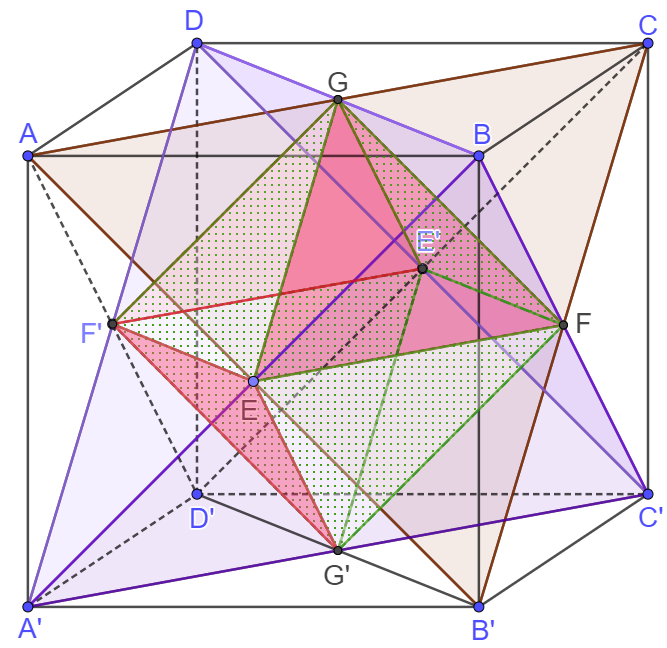
So the intersection part is $EFE’F’GG’$, and all the edges are equal in length which equals to $\dfrac{1}{\sqrt{2}}$, $EFFE’$ is a square, and $GG’=1$
So the volume of $EFE’F’GG’$ is $2 \times \dfrac{GG’}{2} \times \dfrac{1}{3} \times S_{EFE’F’}=\dfrac{1}{2} \times \dfrac{1}{3}=\bbox[5px, border: 1px solid black]{\dfrac{1}{6}}$.
02/24/2021
As shown in the figure, in $\triangle{ABC}$, $BC=a, CA=b, AB=c$ and $a, b, c$ are all positive integers. The greatest common factor of $a$ and $b$ is $2$. $G$ and $I$ are the centroid and incenter of $\triangle{ABC}$, respectively. With $GI \perp CI$, find the perimeter of $\triangle{ABC}$.
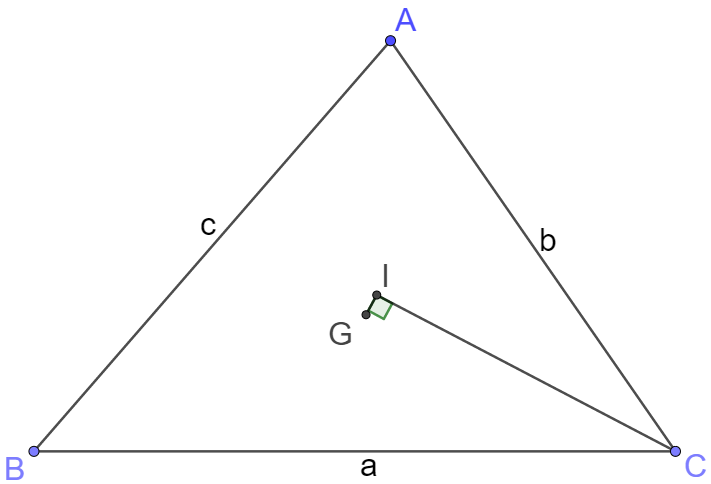
Solve 1:
Using Barycentric coordinates, and try to normalize to the same common base:
$G=((a+b+c) : (a+b+c) : (a+b+c))$
$I = (3a : 3b : 3c)$
$C = (0 : 0 : 3(a+b+c))$
So
$GI=((2a-b-c) : (2b-a-c) : (2c-a-b))$
$CI = (3a : 3b : (-3a-3b))$
According to EFFT(Evan’s Favorite Forgotten Trick), vector $MN=(x_1 : y_1 : z_1), PQ=(x_2 : y_2 : z_2), MN \perp PQ$ iff $0=a^2(y_2z_1 + y_1z_2) + b^2(x_1z_2+x_2z_1) + c^2(x_1y_2 + z_2y_1)$. So
$0=a^2(3b(2c-a-b)-3(a+b)(2b-a-c)) + b^2(3a(2c-a-b)-3(a+b)(2a-b-c)) + c^2(3a(2b-a-c)+3b(2a-b-c))$
$\implies 0=a^2(b(2c-a-b)-(a+b)(2b-a-c))+b^2(a(2c-a-b)-(a+b)(2a-b-c))+c^2(a(2b-a-c)+b(2a-b-c))$
This is a bit hard to do manual factorization but with tools we can:
$\implies (a + b - c) (a + b + c) (a^2 - 4 a b + b^2 + a c + b c) = 0$
Or, we can do MATLAB:
syms a b c
G = [a+b+c a+b+c a+b+c];
I = [3*a 3*b 3*c];
C = [0 0 3*a+3*b+3*c];
GI = I - G;
CI = I - C;
P = a^2 * (GI(2) * CI(3) + GI(3) * CI(2)) + b^2 * (GI(1) * CI(3) + CI(1) * GI(3)) + c^2 * (GI(1) * CI(2) + GI(2) * CI(1));
factor(P)
$\implies a^2 - 4 a b + b^2 + a c + b c = 0 \implies (a+b)(a+b+c)=6ab \implies a+b+c=\dfrac{6ab}{a+b}$
$gcf(a,b)=2 \implies a=2m, b=2n, gcf(m,n)=1, m,n \in \mathbb{Z^+}$
$\implies a+b+c=\dfrac{12mn}{m+n} \in \mathbb{Z^+}, gcf(m,n)=1 \implies (m+n) \mid 12$
$\implies m+n=2, 3, 4, 6, 12 \text{, and } \lvert a-b \lvert \lt c=\dfrac{6ab}{a+b}-a-b \lt a+b $
- $m+n=2 \implies m=n=1 \implies a=b=2 \implies c=2 \implies GI \not\perp CI$
- $m+n=3 \implies m=1, n=2 \text{ or } m=2, n=1 \implies a+b=6, ab=8 \implies c=2= \lvert b-a \lvert $
- $m+n=4 \implies m=1, n=3 \text{ or } m=2, n=2 \text{ or } m=3, n=1 \implies a+b=8, ab=12 \text{ or } 16$ $\implies c=1 \text{ or } 4 \implies GI \not\perp CI \text{ or } c= \lvert b-a \lvert $
- $m+n=6 \implies a+b=12, ab=20 \text{ or } 32 \text{ or } 36 \implies c=4 \text{ or } 6$ $\implies GI \not\perp CI \text{ or } c= \lvert b-a \lvert $
- $m + n = 12 \implies a+b=24, ab=44 \text{ or } 80 \text{ or } 108 \text{ or } 128 \text{ or } 140$ $\implies c=3 \text{ or } 8 \text{ or } 11 \implies c=11, a=14, b=10 \text{ or } c=11, a=10, b=14$ $\implies a+b+c=\bbox[5px, border: 1px solid black]{35}$
Solve 2: (Ref)
Let $D$ and $E$ be the intersections of $GI$ with $CA$ and $BC$ respectively.
$GI \perp CI \implies CD=CE$
Using Trilinear coordinates:
$I=(1 : 1 : 1)$
$G=(\dfrac{1}{a} : \dfrac{1}{b} : \dfrac{1}{c})$
So the equation of $GI$ is: \(\begin{align*} \begin{vmatrix} 1 & 1 & 1 \\ \dfrac{1}{a} & \dfrac{1}{b} & \dfrac{1}{c} \\ x & y & z \end{vmatrix}=0 \implies (\dfrac{1}{c}-\dfrac{1}{b})x+(\dfrac{1}{a}-\dfrac{1}{c})y+(\dfrac{1}{b}-\dfrac{1}{a})z=0 \end{align*}\) and $A=(1 : 0 : 0), C=(0 : 0 : 1)$, the equation of $AC$ is $y=0$, thus intersection $D$ is determined by
$(\dfrac{1}{c}-\dfrac{1}{b})x+(\dfrac{1}{b}-\dfrac{1}{a})z=0 \implies a(b-c)x + c(a-b)z=0$
$\implies D=(c(b-a) : 0 : a(b-c))$
Similarly, $B=(0 : 1 : 0)$, the equation of $BC$ is $x=0$, thus intersection $E$ is determined by
$(\dfrac{1}{a}-\dfrac{1}{c})y+(\dfrac{1}{b}-\dfrac{1}{a})z=0 \implies b(c-a)y + c(a-b)z=0$
$\implies E=(0 : c(a-b) : b(a-c))$
$CD=DE \implies d(D, BC) = d(E, AC)$
We know the actual distances of point with trilinear coordinate $(x:y:z)$ from the sides $BC, CA, AB$ are given by $a’=kx, b’=ky, c’=kz$ where $k=\dfrac{2S_{\triangle{ABC}}}{ax+by+cz}$, so
$d(D, BC)=c(b-a)k = c(b-a)\dfrac{2S_{\triangle{ABC}}}{ac(b-a) + ac(b-c)}$
$d(E, AC)=b(a-c)k = c(a-b)\dfrac{2S_{\triangle{ABC}}}{bc(a-b) + bc(a-c)}$
$d(D, BC)=d(E, AC) \implies ac(a+c-2b)=bc(2a-b-c) \implies (a+b)(a+b+c)=6ab$
Solve 3:
Let $D$ and $E$ be the intersections of $GI$ with $CA$ and $BC$ respectively. Suppose the distances from $G$ to $AC$ and $BC$ are $h_1$ and $h_2$ respectively.
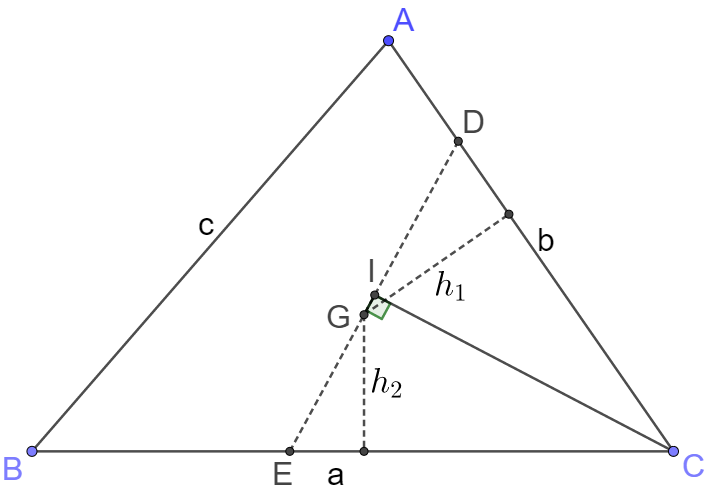
$GI \perp CI \implies CD=CE$
$S_{\triangle{CDE}}=CD \times r_{incenter}=\dfrac{1}{2}CD(h_1+h_2)$
$S_{\triangle{ABC}}=p\times r_{incenter}=\dfrac{1}{2}a \times 3h_1=\dfrac{1}{2}b \times 3h_2$
$\implies h_1=\dfrac{2S_{\triangle{ABC}}}{3b}, h_2=\dfrac{2S_{\triangle{ABC}}}{3a}, r_{incenter}=\dfrac{2S_{\triangle{ABC}}}{a+b+c}$
$\implies \dfrac{4S_{\triangle{ABC}}}{a+b+c}=2r=h_1+h_2=\dfrac{2S_{\triangle{ABC}}}{3a}+\dfrac{2S_{\triangle{ABC}}}{3b}$
$\implies (a+b)(a+b+c)=6ab$
References:
02/25/2021
Suppose $n=2^{499}$. There are $2n$ points on a circle and they are numbered as $1, 2, … 2n$. Prove: there exists 100 secants connecting these points but no intersection to each other, so that the endpoints of these secants can be
–
02/26/2021
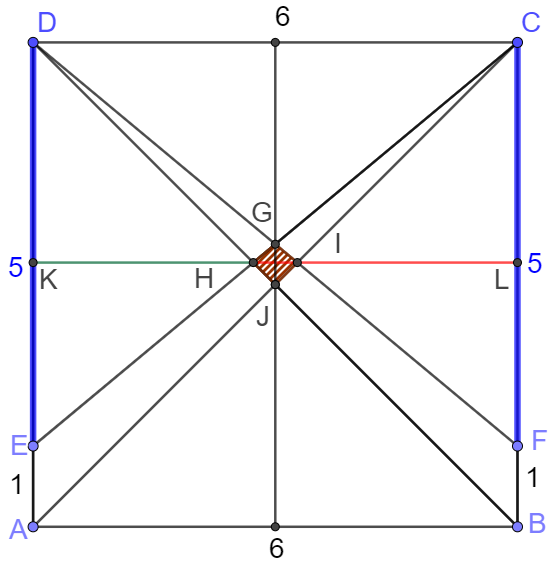
As shown in figure. find the area of quadrilateral $GHIJ:$
Solve:
$GJ=\dfrac{EA}{2}=\dfrac{1}{2}$
$\dfrac{HK}{HL}=\dfrac{DE}{BC}=\dfrac{5}{6}, HK+HL=6 \implies HK=\dfrac{30}{11}, HL=\dfrac{36}{11} \implies HI=\dfrac{6}{11}$
$S_{GIHJ}=GJ \times HI \times \dfrac{1}{2}=\dfrac{1}{2} \times \dfrac{6}{11} \times \dfrac{1}{2}=\bbox[5px, border: 1px solid black]{\dfrac{3}{22}}$
02/26/2021
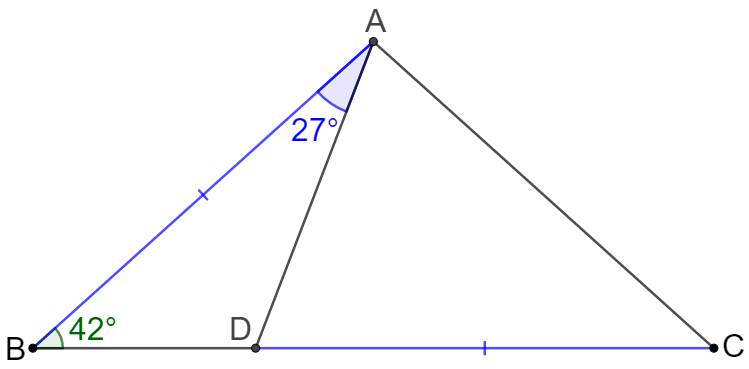
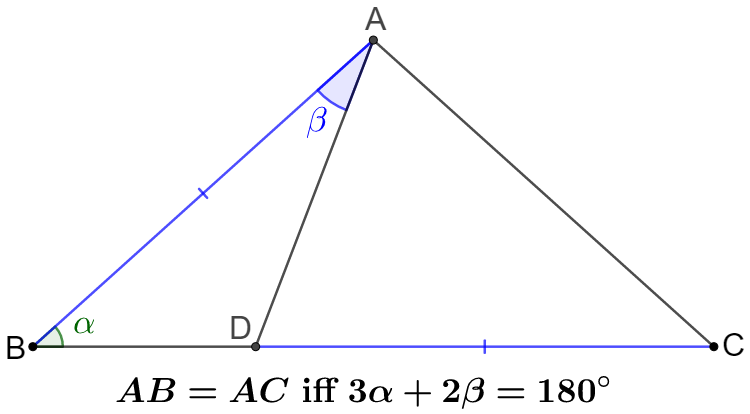
$D$ is a point on $BC$ In $\triangle{ABC}$, $\angle{ABC}=42^{\circ}, \angle{BAD}=27^{\circ}, AB=CD$, prove that $AB=AC.$
Proof:
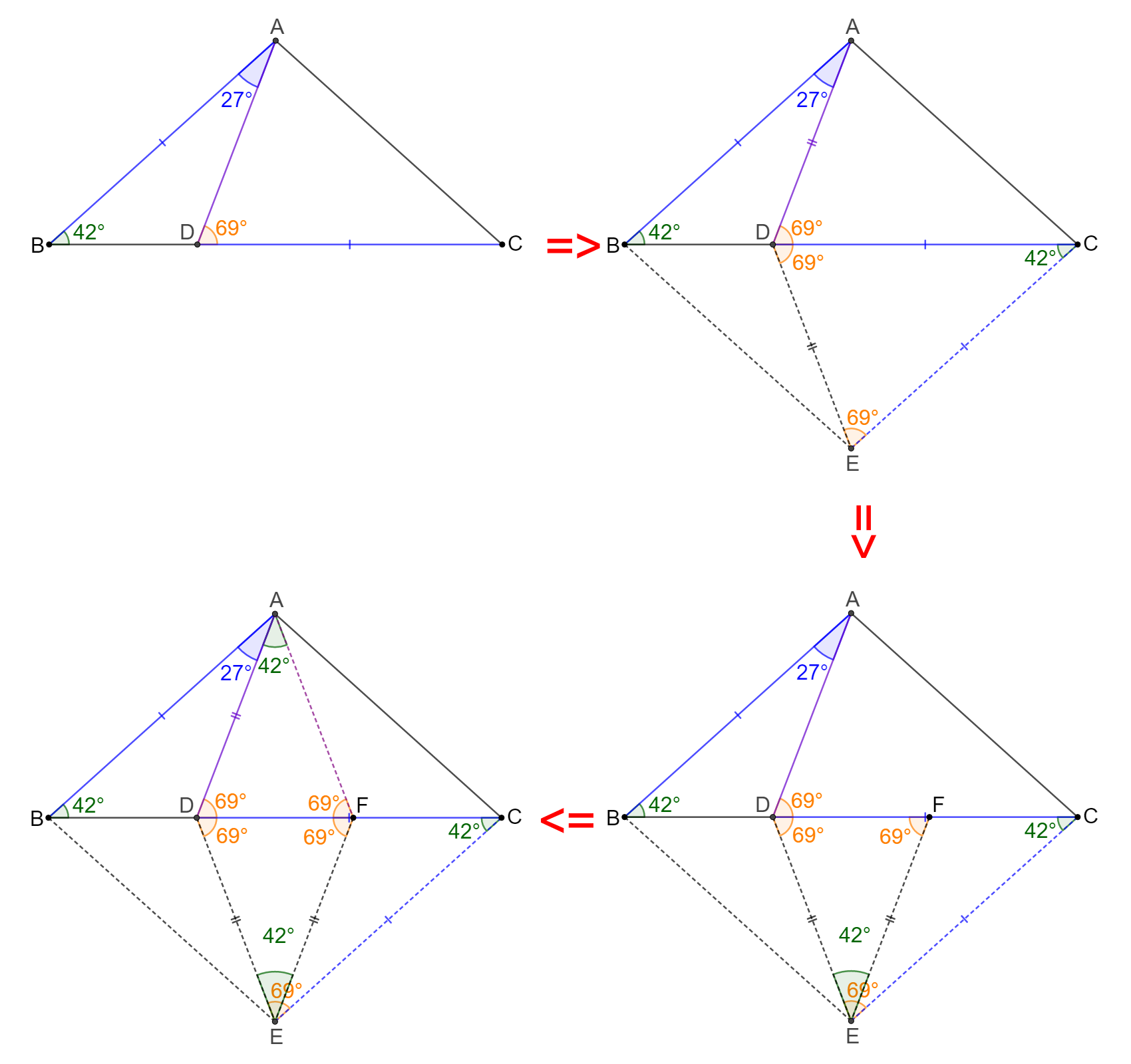
-
Step 1: make $CE \parallel AB, CE=AB \implies AB=CD=CE \implies \angle{BCE}=\angle{ABC}=42^{\circ}, \angle{CED}=\angle{CDE}=69^{\circ}$
-
Step 2: make $EF \parallel AD \implies \angle{DFE}=\angle{ADF}=69^{\circ} \implies DE=DF$ and $\angle{DEF}=42^{\circ} \implies \angle{CEF}=27^{\circ} \implies \triangle{ABD} \cong \triangle{CEF} \implies AD=EF$
-
Step 3: $AD\parallel EF, AD=EF \implies AF \parallel DE, DE=AF=AD=EF \implies \triangle{ACD} \cong \triangle{CDE} \implies CE=AC=AB \blacksquare$
-
Reflection:
02/27/2021
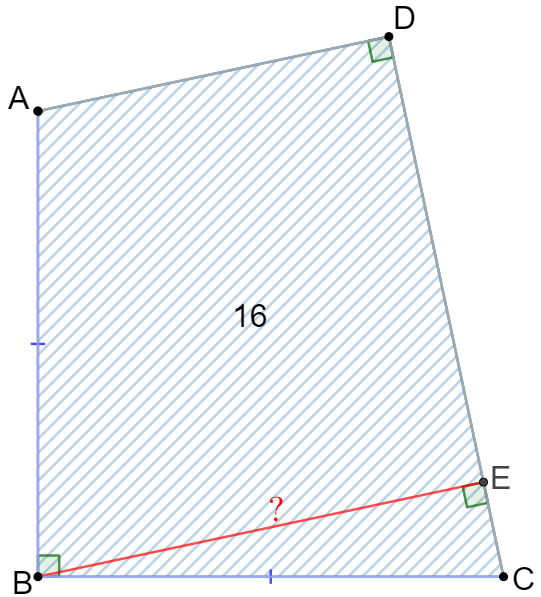
In the following figure, $S_{ABCD}=16, AB=BC, BE \perp CD$, find $BE.$
Solve 1:
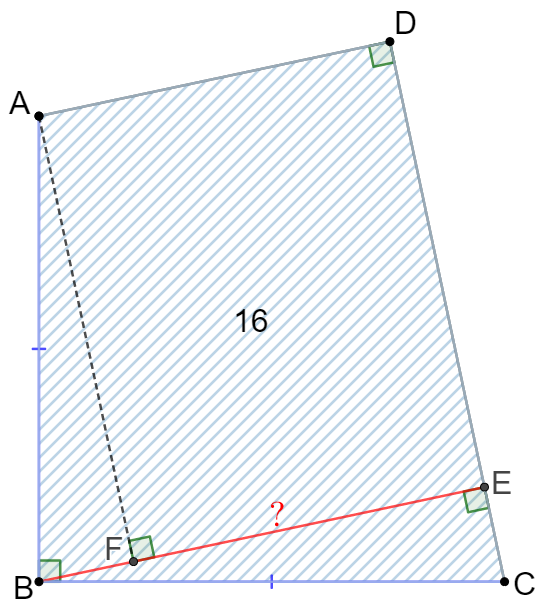
Let $AB=BC=a, AD=b, CD=c, BE=x$
$S_{ABCD}=16 \implies a^2+bc=32$
$2a^2=b^2+c^2 \implies 64-2bc=b^2+c^2 \implies b+c=8$
Make $F$ on $BE$ so that $AF \perp BE \implies \angle{CBE}=\angle{BAF}$
$AB=BC \implies \triangle{BCE} \cong \triangle{ABF} \implies AF=BE, BF=CE \implies x=b+\sqrt{a^2-x^2}$
$\implies 2x^2-2bx+b^2-a^2=0 \implies x=\dfrac{2b\pm\sqrt{4b^2-8(b^2-a^2)}}{4}=\dfrac{b\pm\sqrt{2a^2-b^2}}{2}=\dfrac{b\pm c}{2}$
$x=\dfrac{b-c}{2} \implies a^2-x^2=a^2-\dfrac{b^2+c^2-2bc}{4}=\dfrac{2a^2-b^2-c^2+2a^2+2bc}{4}=\dfrac{64}{4}=16 \implies BF=CE=4$
$\implies x=c-4 \implies \dfrac{b-c}{2}=c-4 \implies 3c-b=8=b+c \implies b=c=4 \implies x=0$
This does not make sense, since when $b=c=4, x=4$
So the answer is $BE=x=\dfrac{b+c}{2}=\bbox[5px, border: 1px solid black]{4}$
Solve 2:
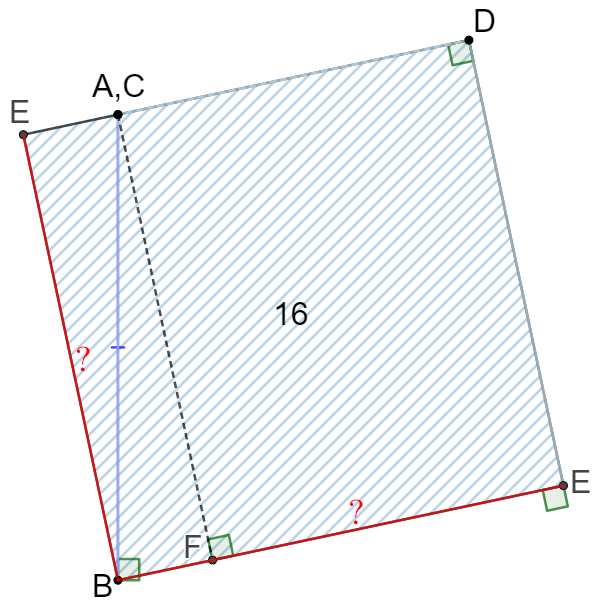
Rotate $\triangle{BCE}$ by $90^{\circ}$ anti-clockwise, so the area of $ABCD$ is 16 and it forms a square with side $BE$. So $BE=\bbox[5px, border: 1px solid black]{4}$.
02/28/2021
Find value of $\angle{x}$ in the following figure:
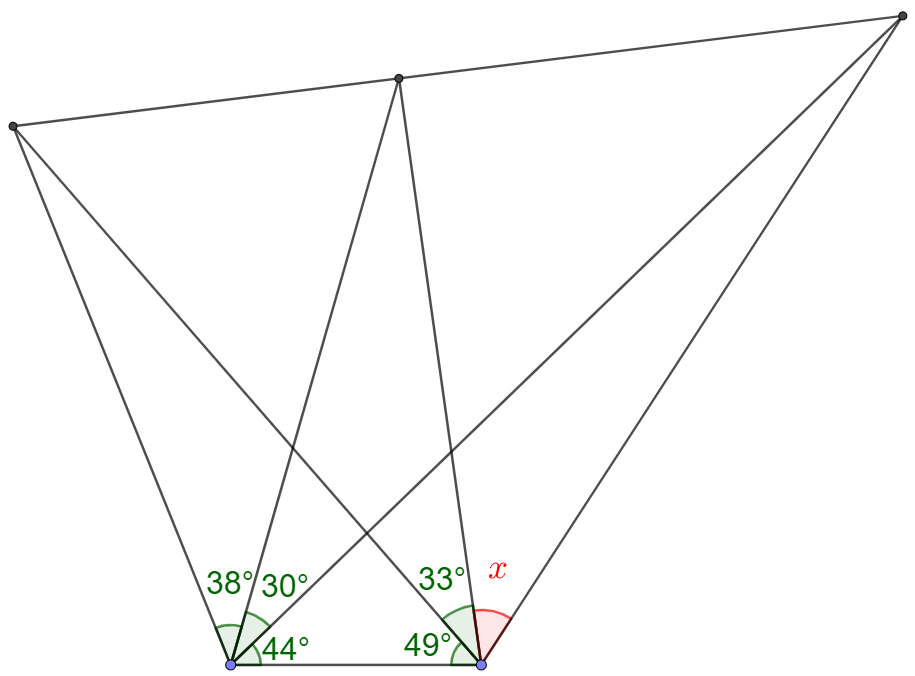
Solute 1:
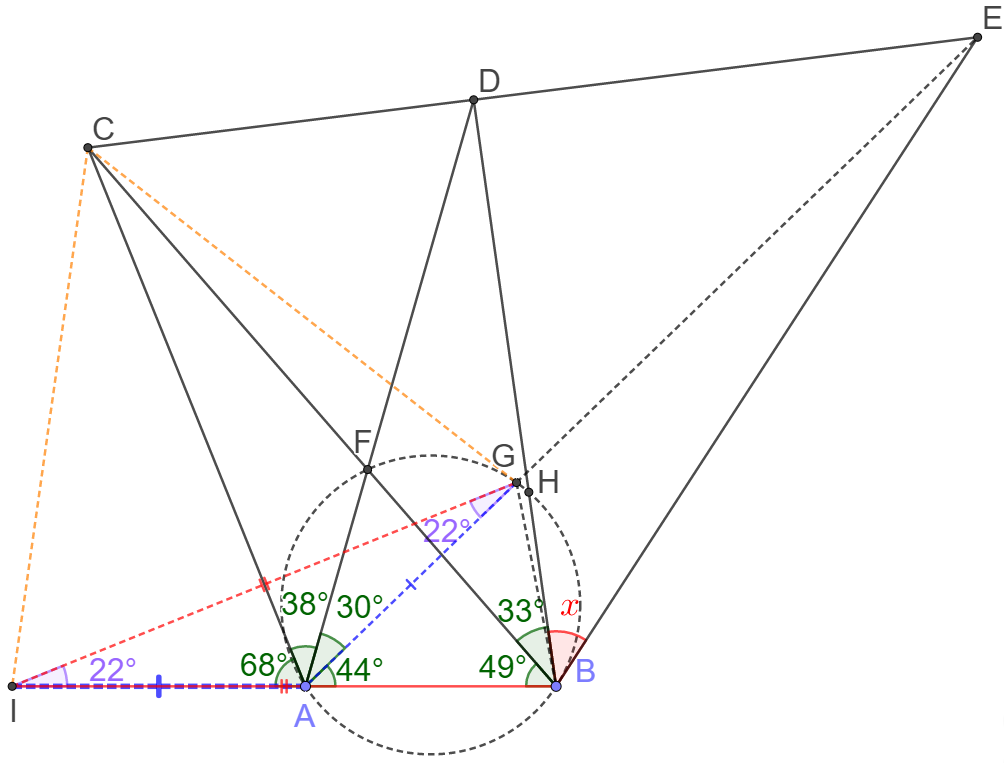
Suppose points $A,B,C,D,E$ are the vertices in the figure.
-
Mark $AD$ and $BC$ intersects at point $F$, draw circle {$ABF$} that passes through the three points. The circle and $AE, BD$ intersects at point $G, H$ respectively.
-
Extend $BA$ to point $I$ so that $AG=AI$, easy to see that
$\angle{GAC}=38^{\circ}+30^{\circ}=68^{\circ}$
$ \implies \angle{CAI}=180^{\circ}-\angle{GAC}-\angle{GAB}$
$=180^{\circ}-68^{\circ}-44^{\circ}=68^{\circ}$
$AI=AG \implies \angle{GIA}=\angle{AGI}$
$=\dfrac{180^{\circ}-\angle{GAC}-\angle{CAI}}{2}$
$=\dfrac{180^{\circ}-68^{\circ}-68^{\circ}}{2}=22^{\circ}$
$\angle{AFB}=180^{\circ}-\angle{FAB}-\angle{FBA}$
$=180^{\circ}-30^{\circ}-44^{\circ}-49^{\circ}=57^{\circ} \implies \angle{AGB}=57^{\circ}$
$\implies \angle{IGB}=22^{\circ}+57^{\circ}=79^{\circ}$
$ \implies \angle{GBI}=180^{\circ}-\angle{GIA}-\angle{IGB}$
$=180^{\circ}-22^{\circ}-79^{\circ}=79^{\circ} \implies IG=IB$
$\angle{GBI}=79^{\circ} \implies \angle{GBC}=79^{\circ}-49^{\circ}=30^{\circ}$
-
$IG=IB, \angle{GAC}=\angle{CAI} \implies AC$ is vertical bisector of $IG$, and $\angle{GBC}=30^{\circ}$. We will prove that $\triangle{CGI}$ is equilateral triangle.
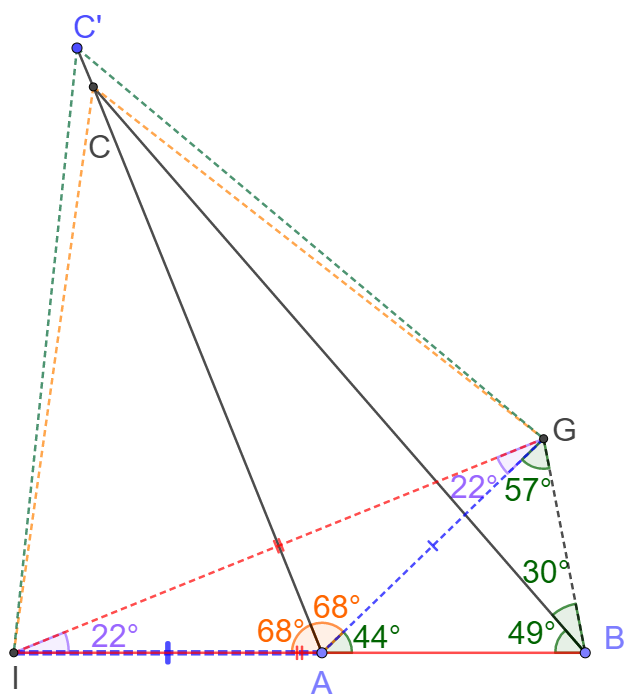
From above we know that point $C$ is intersect of $AC$ and $CB$, where $AC$ is vertical bisector of $IG$ and $\angle{GBC}=30^{\circ}$. Now suppose we make an equilateral triangle $\triangle{GIC’}$, and connect $BC’$, since $C’I=IG=IB$, we know $I$ is the center of the circle passes $G,B,C’$, $\angle{C’IG}=60^{\circ} \implies \angle{C’BG}=30^{\circ}$. That means $C’=C \implies \triangle{CGI}$ is equilateral.
-
Now we prove points $C,G,H$ is colinear. This is easy to see that $\angle{CGA}=\angle{CGI}+\angle{IGA}=60^{\circ}+22^{\circ}=82^{\circ}$, and since points $A,G,H,B$ is cyclic, $\angle{AGH}=180^{\circ}-\angle{HBA}=180^{\circ}-(33^{\circ}+49^{\circ})=180^{\circ}-82^{\circ}$, so $\angle{CGA}+\angle{AGH}=82^{\circ}+180^{\circ}-82^{\circ}=180^{\circ}$. This means points $C,G,H$ is colinear.
-
Now we have 5 points $A, F, G, H, B$ on the circle, with $BF$ and $HG$ intersects at point $C$, $AF$ and $BH$ intersects at point D, $AG$ and $BE$ intersects at point $E$, and points $C, D, E$ are colinear. From Pascal Theorem we know that, this is a degeneration situation of 5 points, and point $BE$ is tangent to the circle.
-
Since $BE$ is tangent to the circle, we know that $\angle{FBE}=\angle{FAB}=30^{\circ}+44^{\circ}=74^{\circ} \implies \angle{HBE}=74^{\circ}-33^{\circ}=\bbox[5px, border: 1px solid black]{41^{\circ}}$
Solute 2:
Solve the problem in analytical approach
syms x
A= [1, -tan(deg2rad(49))/(tan(deg2rad(68))-tan(deg2rad(49))), tan(deg2rad(68))*tan(deg2rad(49))/(tan(deg2rad(68))-tan(deg2rad(49)));...
    1, tan(deg2rad(82))/(tan(deg2rad(82))+tan(deg2rad(74))), tan(deg2rad(82))*tan(deg2rad(74))/(tan(deg2rad(82))+tan(deg2rad(74)));...
    1, tan(deg2rad(98-x))/(tan(deg2rad(98-x))-tan(deg2rad(44))),   tan(deg2rad(98-x))*tan(deg2rad(44))/(tan(deg2rad(98-x))-tan(deg2rad(44)))];
vpasolve(det(A) == 0)
And the output is:
ans =

41.000000000000014760621965150125
Reference: