06/09/2026
$P$ is a point inside $\triangle{ABC}$ such that $\angle{ABP}=40^{\circ}$, $\angle{PBC}=30^{\circ}$, $\angle{ACP}=10^{\circ}$, $\angle{BCP}=20^{\circ}$, find $\angle{BAP}$
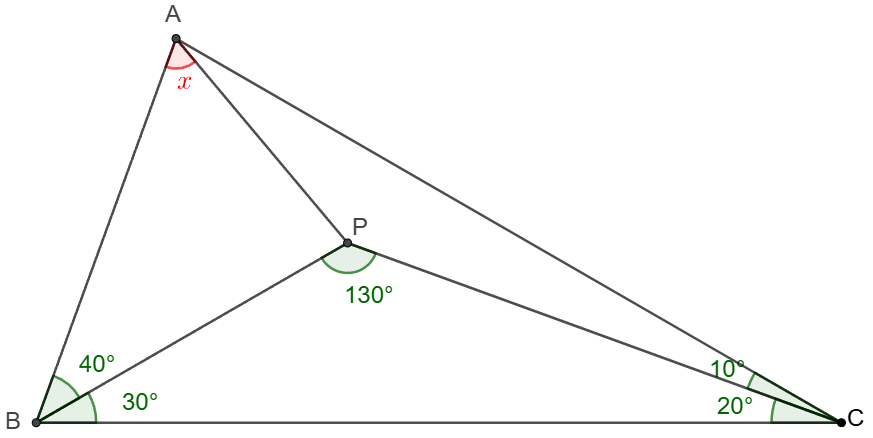
Solve:
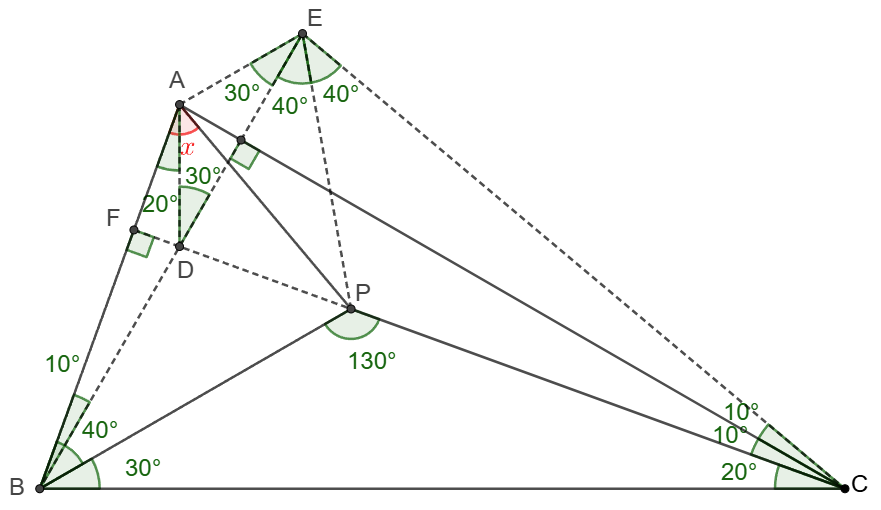 \(\begin{multline}
\shoveleft \text{Easy to see }CP\perp AB, \angle{BAC}=80^{\circ}\\
\shoveleft \text{Make }BE \perp AC \text{ such that }\angle{ACE}=10^{\circ}, BE\cap CP=D, CP\cap AB=F\\
\shoveleft \implies D \text{ is the orthocenter of }\triangle{ABC} \implies \angle{BAD}=20^{\circ}, \angle{ABD}=10^{\circ} \\
\shoveleft\implies \angle{ADF}=70^{\circ},\angle{EBP}=30^{\circ}, \angle{DAC}=60^{\circ}\implies \angle{ADE}=30^{\circ}\\
\shoveleft AC\perp DE, \angle{ACE}=\angle{ACD}=10^{\circ}\implies \triangle{ACE}\cong\triangle{ACD}\\
\shoveleft \implies AD=AE \implies \angle{AED}=\angle{ADE}=30^{\circ}\\
\shoveleft \angle{EBP}=\angle{CBP}, \angle{ECP}=\angle{BCP}\implies P \text{ is the incenter of }\triangle{EBC}\\
\shoveleft \implies \angle{BEP}=\angle{CEP}=40^{\circ}\implies \angle{AEP}=70^{\circ}=\angle{ADF}\\
\shoveleft \implies ADPE \text{ is cyclic }\implies \angle{DAP}=\angle{BEP}=40^{\circ}\implies \angle{BAP}=\bbox[5px, border: 1px solid black]{60^{\circ}}
\end{multline}\)
\(\begin{multline}
\shoveleft \text{Easy to see }CP\perp AB, \angle{BAC}=80^{\circ}\\
\shoveleft \text{Make }BE \perp AC \text{ such that }\angle{ACE}=10^{\circ}, BE\cap CP=D, CP\cap AB=F\\
\shoveleft \implies D \text{ is the orthocenter of }\triangle{ABC} \implies \angle{BAD}=20^{\circ}, \angle{ABD}=10^{\circ} \\
\shoveleft\implies \angle{ADF}=70^{\circ},\angle{EBP}=30^{\circ}, \angle{DAC}=60^{\circ}\implies \angle{ADE}=30^{\circ}\\
\shoveleft AC\perp DE, \angle{ACE}=\angle{ACD}=10^{\circ}\implies \triangle{ACE}\cong\triangle{ACD}\\
\shoveleft \implies AD=AE \implies \angle{AED}=\angle{ADE}=30^{\circ}\\
\shoveleft \angle{EBP}=\angle{CBP}, \angle{ECP}=\angle{BCP}\implies P \text{ is the incenter of }\triangle{EBC}\\
\shoveleft \implies \angle{BEP}=\angle{CEP}=40^{\circ}\implies \angle{AEP}=70^{\circ}=\angle{ADF}\\
\shoveleft \implies ADPE \text{ is cyclic }\implies \angle{DAP}=\angle{BEP}=40^{\circ}\implies \angle{BAP}=\bbox[5px, border: 1px solid black]{60^{\circ}}
\end{multline}\)
06/10/2026
The radius of circle $\odot{O}$ is $5\sqrt{2}$, $AB$ is a chord with length $AB=14$, $D$ is a point on the circle such that $CD\perp AC$, find the maximum value of $AC+CD$
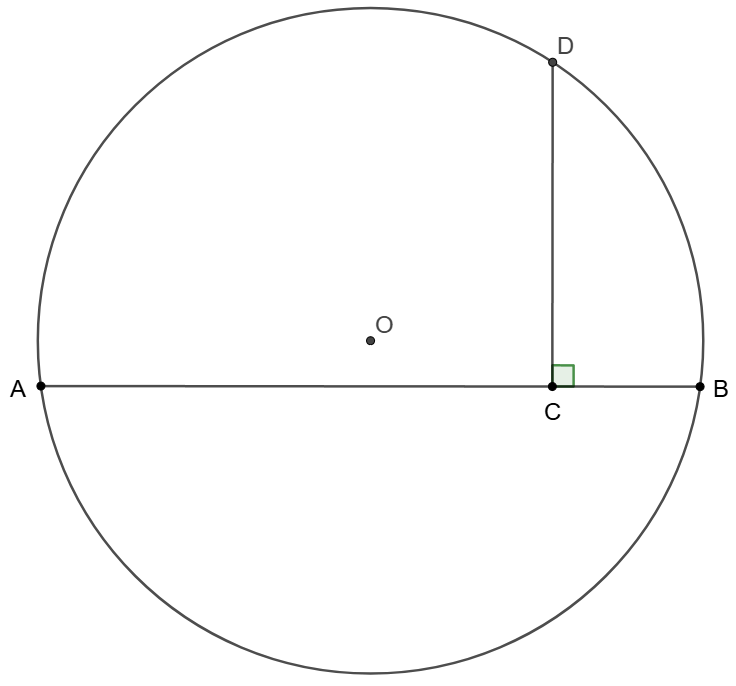
Solve 1:
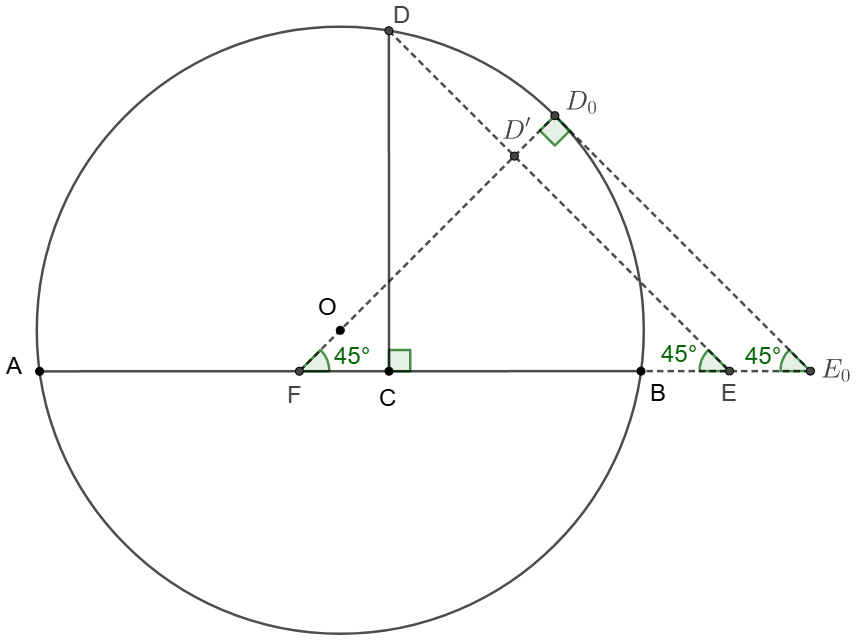 \(\begin{multline}
\shoveleft \text{From }D \text{ make }E \text{ on extended }AB \text{ such that }\angle{DEA}=45^{\circ}\\
\shoveleft \text{From }O \text{ make }F \text{ on }AB \text{ such that }\angle{OFB}=45^{\circ}\\
\shoveleft \text{Let } FO\cap \odot{O}=D_0, DE \cap D_0F=D'\\
\shoveleft \implies AC+CD=AC+CE=AF+EF=AF+\sqrt{2}(OF+OD')\\
\shoveleft AB=14, OA=5\sqrt{2} \implies OF=\sqrt{2}, AF=6, BF=8\\
\shoveleft \implies AC+CD=6+2+\sqrt{2}OD'=8+\sqrt{2}OD'\\
\shoveleft OD'_{max}=OA=5\sqrt{2} \text{ when }D_0F \perp D_0E_0, D_0E_0 \cap AB=E_0\\
\shoveleft \implies (AC+CD)_{max}=8+\sqrt{2}\cdot 5\sqrt{2}=\bbox[5px, border: 1px solid black]{18}
\end{multline}\)
Solve 2:
\(\begin{multline}
\shoveleft \text{From }D \text{ make }E \text{ on extended }AB \text{ such that }\angle{DEA}=45^{\circ}\\
\shoveleft \text{From }O \text{ make }F \text{ on }AB \text{ such that }\angle{OFB}=45^{\circ}\\
\shoveleft \text{Let } FO\cap \odot{O}=D_0, DE \cap D_0F=D'\\
\shoveleft \implies AC+CD=AC+CE=AF+EF=AF+\sqrt{2}(OF+OD')\\
\shoveleft AB=14, OA=5\sqrt{2} \implies OF=\sqrt{2}, AF=6, BF=8\\
\shoveleft \implies AC+CD=6+2+\sqrt{2}OD'=8+\sqrt{2}OD'\\
\shoveleft OD'_{max}=OA=5\sqrt{2} \text{ when }D_0F \perp D_0E_0, D_0E_0 \cap AB=E_0\\
\shoveleft \implies (AC+CD)_{max}=8+\sqrt{2}\cdot 5\sqrt{2}=\bbox[5px, border: 1px solid black]{18}
\end{multline}\)
Solve 2:
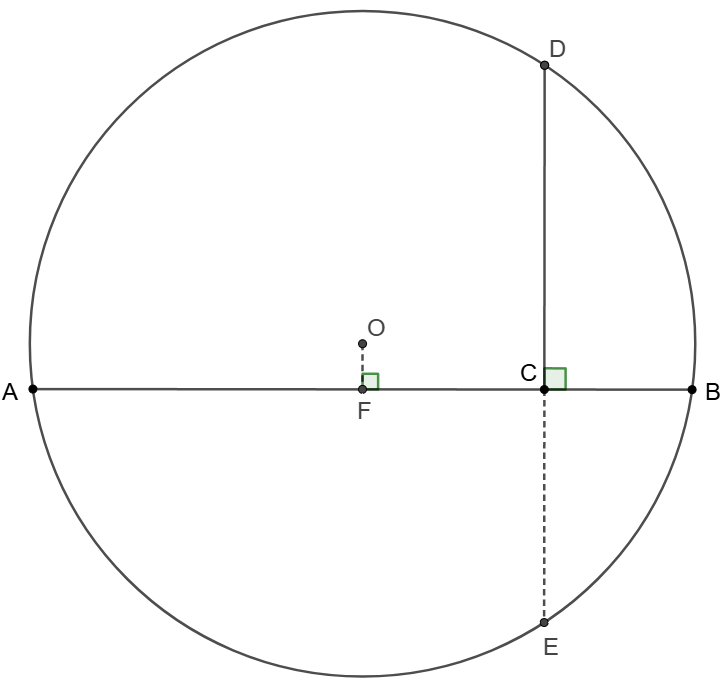 \(\begin{multline}
\shoveleft \text{Make }OF \perp AB, OF \cap AB=F, CD \cap \odot{O}=E\\
\shoveleft AB=14, OA=5\sqrt{2}\implies OF=1\\
\shoveleft \text{Let }AC=a, CD=b \implies BC=14-a, CE=b-2\\
\shoveleft AC^2+BC^2+CD^2+CD^2=4(5\sqrt{2})^2\\
\shoveleft \implies (a-7)^2+(b-1)^2=50\\
\shoveleft \implies \text{This is a circle center at (7,1) with radius }5\sqrt{2}\\
\shoveleft (a+b)_{max} \text{ is the line }b=-a+k \text{ that is tangent to the circle} \\
\shoveleft \implies (AC+CD)_{max}=8+\sqrt{2}\cdot 5\sqrt{2}=\bbox[5px, border: 1px solid black]{18}
\end{multline}\)
\(\begin{multline}
\shoveleft \text{Make }OF \perp AB, OF \cap AB=F, CD \cap \odot{O}=E\\
\shoveleft AB=14, OA=5\sqrt{2}\implies OF=1\\
\shoveleft \text{Let }AC=a, CD=b \implies BC=14-a, CE=b-2\\
\shoveleft AC^2+BC^2+CD^2+CD^2=4(5\sqrt{2})^2\\
\shoveleft \implies (a-7)^2+(b-1)^2=50\\
\shoveleft \implies \text{This is a circle center at (7,1) with radius }5\sqrt{2}\\
\shoveleft (a+b)_{max} \text{ is the line }b=-a+k \text{ that is tangent to the circle} \\
\shoveleft \implies (AC+CD)_{max}=8+\sqrt{2}\cdot 5\sqrt{2}=\bbox[5px, border: 1px solid black]{18}
\end{multline}\)
06/11/2026
$\triangle{ABC}$ is a right triangle with $\angle{ABC}=90^{\circ}$, $AC=6$, find the maximum value of $AB+\dfrac{BC}{\sqrt{3}}$
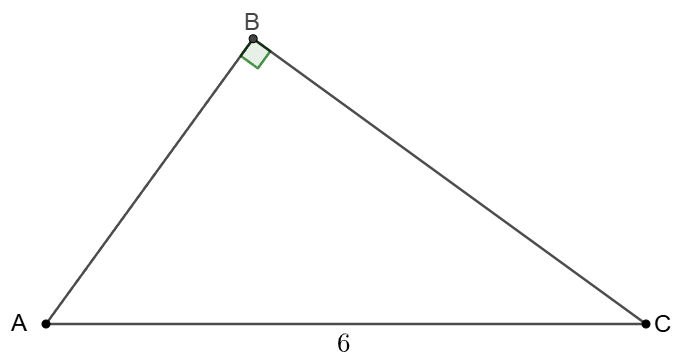
Solve:
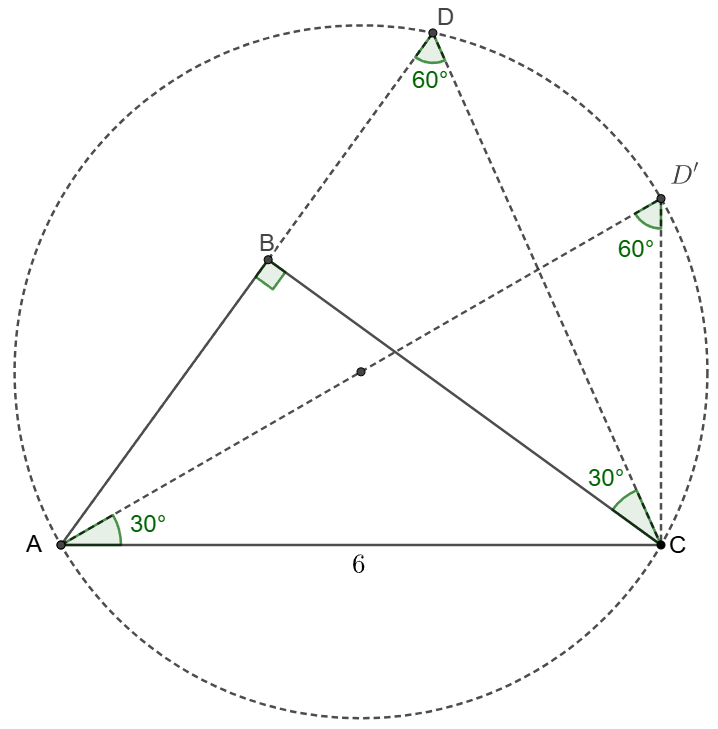 \(\begin{multline}
\shoveleft \text{Extend }AB \text{ to }D \text{ such that }\angle{BCD}=30^{\circ}\\
\shoveleft \implies AB+\dfrac{BC}{\sqrt{3}}=AB+BD=AB, \angle{ADC}=60^{\circ}\\
\shoveleft \implies AB+\dfrac{BC}{\sqrt{3}}\text{ get maximum value when }\\
\shoveleft AD' \text{ is the diameter of circumcircle of }\triangle{ADC}\\
\shoveleft \implies \angle{D'AC}=30^{\circ}\implies (AB+\dfrac{BC}{\sqrt{3}})_{max}=AD'=\bbox[5px, border: 1px solid black]{4\sqrt{3}}
\end{multline}\)
\(\begin{multline}
\shoveleft \text{Extend }AB \text{ to }D \text{ such that }\angle{BCD}=30^{\circ}\\
\shoveleft \implies AB+\dfrac{BC}{\sqrt{3}}=AB+BD=AB, \angle{ADC}=60^{\circ}\\
\shoveleft \implies AB+\dfrac{BC}{\sqrt{3}}\text{ get maximum value when }\\
\shoveleft AD' \text{ is the diameter of circumcircle of }\triangle{ADC}\\
\shoveleft \implies \angle{D'AC}=30^{\circ}\implies (AB+\dfrac{BC}{\sqrt{3}})_{max}=AD'=\bbox[5px, border: 1px solid black]{4\sqrt{3}}
\end{multline}\)
06/12/2026
Find the minimum value of $\sqrt{x^2+9}+\sqrt{x^2-14x+65}$
Solve:
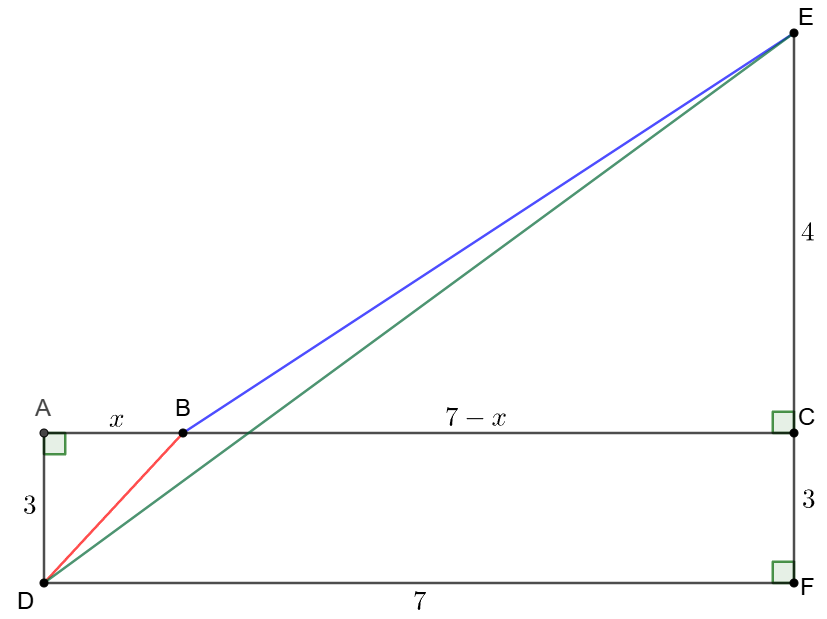 \(\begin{multline}
\shoveleft \sqrt{x^2+9}+\sqrt{x^2-14x+65}=\sqrt{x^2+3^2}+\sqrt{(x-7)^2+4^2}\\
\shoveleft \implies \text{Let }AB=x, AD=3, AD\perp AB \implies BD=\sqrt{x^2+9}\\
\shoveleft \text{Extend }AB \text{ to }C \text{ such that }BC=7-x, EC\perp AC, EC=4\\
\shoveleft \implies BE=\sqrt{x^2-14x+65}\implies BD+BE\ge ED=\sqrt{DF^2+EF^2}\\
\shoveleft DF=AC=7, EF=EC+CF=4+3=7 \implies\\
\shoveleft ({x^2+9}+\sqrt{x^2-14x+65})_{min}=\bbox[5px, border: 1px solid black]{7\sqrt{2}}
\end{multline}\)
\(\begin{multline}
\shoveleft \sqrt{x^2+9}+\sqrt{x^2-14x+65}=\sqrt{x^2+3^2}+\sqrt{(x-7)^2+4^2}\\
\shoveleft \implies \text{Let }AB=x, AD=3, AD\perp AB \implies BD=\sqrt{x^2+9}\\
\shoveleft \text{Extend }AB \text{ to }C \text{ such that }BC=7-x, EC\perp AC, EC=4\\
\shoveleft \implies BE=\sqrt{x^2-14x+65}\implies BD+BE\ge ED=\sqrt{DF^2+EF^2}\\
\shoveleft DF=AC=7, EF=EC+CF=4+3=7 \implies\\
\shoveleft ({x^2+9}+\sqrt{x^2-14x+65})_{min}=\bbox[5px, border: 1px solid black]{7\sqrt{2}}
\end{multline}\)
06/13/2026
If $x+y=2$, $x, y > 0$, find the minimum value of $x+\sqrt{x^2+3y^2}$
Solve:
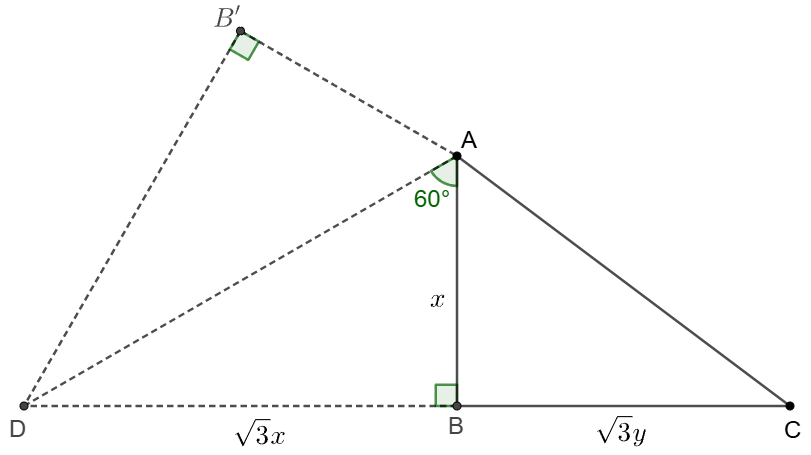 \(\begin{multline}
\shoveleft \text{Let }AB=x, BC=\sqrt{3}y, AB\perp BC \implies AC=\sqrt{x^2+3y^2}\\
\shoveleft \text{Extend }CB \text{ to }D \text{ such that }BD=\sqrt{3}x \implies CD=2\sqrt{3}, \angle{ADC}=30^{\circ}\\
\shoveleft \text{Let }B' \text{ be the reflection of }B \text{ along }AD \implies AB+AC=AB'+AC\\
\shoveleft B \text{ is a dynamic point on fixed segment }CD \implies B', C \text{ are fixed points}\\
\shoveleft \implies AB'+AC \text{ gets minimum value when } AB', AC \text{ collinear}\\
\shoveleft \implies \angle{BAC}=60^{\circ}\implies x=y=1 \implies (x+\sqrt{x^2+3y^2})_{min}=\bbox[5px, border: 1px solid black]{2}
\end{multline}\)
\(\begin{multline}
\shoveleft \text{Let }AB=x, BC=\sqrt{3}y, AB\perp BC \implies AC=\sqrt{x^2+3y^2}\\
\shoveleft \text{Extend }CB \text{ to }D \text{ such that }BD=\sqrt{3}x \implies CD=2\sqrt{3}, \angle{ADC}=30^{\circ}\\
\shoveleft \text{Let }B' \text{ be the reflection of }B \text{ along }AD \implies AB+AC=AB'+AC\\
\shoveleft B \text{ is a dynamic point on fixed segment }CD \implies B', C \text{ are fixed points}\\
\shoveleft \implies AB'+AC \text{ gets minimum value when } AB', AC \text{ collinear}\\
\shoveleft \implies \angle{BAC}=60^{\circ}\implies x=y=1 \implies (x+\sqrt{x^2+3y^2})_{min}=\bbox[5px, border: 1px solid black]{2}
\end{multline}\)
06/14/2026
Find the maximum value of $\sqrt{x^2+10x+41}-\sqrt{x^2+1}$ for $x>0$
Solve 1:
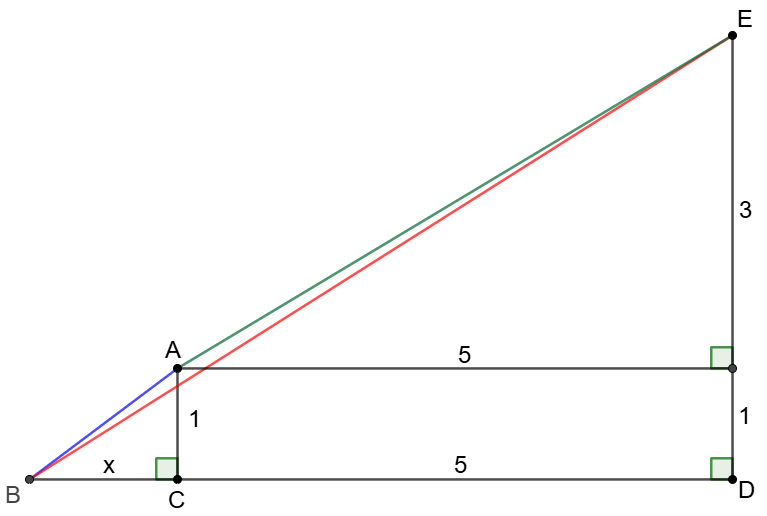 \(\begin{multline}
\shoveleft \sqrt{x^2+10x+41}-\sqrt{x^2+1}=\sqrt{(x+5)^2+4^2}-\sqrt{x^2+1}\\
\shoveleft \text{Make }AC=1, BC \perp AC, BC=x, \text{extend }BC \text{ to }D \text{ such that }\\
\shoveleft CD=5, \text{make }DE \perp CD, DE=1, \text{extend }DE \text{ to }F \text{ such that }\\
\shoveleft EF=3 \implies \sqrt{x^2+10x+41}-\sqrt{x^2+1}=BE-AB\le AE\\
\shoveleft \implies (\sqrt{x^2+10x+41}-\sqrt{x^2+1})_{max}=AE=\bbox[5px, border: 1px solid black]{\sqrt{34}}
\end{multline}\)
Solve 2:
\(\begin{multline}
\shoveleft \sqrt{x^2+10x+41}-\sqrt{x^2+1}=\sqrt{(x+5)^2+4^2}-\sqrt{x^2+1}\\
\shoveleft \text{Let }\overrightarrow{m}(x+5,4), \overrightarrow{n}(x, 1) \implies \sqrt{(x+5)^2+4^2}-\sqrt{x^2+1}=|\overrightarrow{m}|-|\overrightarrow{n}|\\
\shoveleft \le |\overrightarrow{m}-\overrightarrow{n}|=|(5,3)|=\sqrt{34}\implies (\sqrt{x^2+10x+41}-\sqrt{x^2+1})_{max}=\bbox[5px, border: 1px solid black]{\sqrt{34}}
\end{multline}\)
\(\begin{multline}
\shoveleft \sqrt{x^2+10x+41}-\sqrt{x^2+1}=\sqrt{(x+5)^2+4^2}-\sqrt{x^2+1}\\
\shoveleft \text{Make }AC=1, BC \perp AC, BC=x, \text{extend }BC \text{ to }D \text{ such that }\\
\shoveleft CD=5, \text{make }DE \perp CD, DE=1, \text{extend }DE \text{ to }F \text{ such that }\\
\shoveleft EF=3 \implies \sqrt{x^2+10x+41}-\sqrt{x^2+1}=BE-AB\le AE\\
\shoveleft \implies (\sqrt{x^2+10x+41}-\sqrt{x^2+1})_{max}=AE=\bbox[5px, border: 1px solid black]{\sqrt{34}}
\end{multline}\)
Solve 2:
\(\begin{multline}
\shoveleft \sqrt{x^2+10x+41}-\sqrt{x^2+1}=\sqrt{(x+5)^2+4^2}-\sqrt{x^2+1}\\
\shoveleft \text{Let }\overrightarrow{m}(x+5,4), \overrightarrow{n}(x, 1) \implies \sqrt{(x+5)^2+4^2}-\sqrt{x^2+1}=|\overrightarrow{m}|-|\overrightarrow{n}|\\
\shoveleft \le |\overrightarrow{m}-\overrightarrow{n}|=|(5,3)|=\sqrt{34}\implies (\sqrt{x^2+10x+41}-\sqrt{x^2+1})_{max}=\bbox[5px, border: 1px solid black]{\sqrt{34}}
\end{multline}\)
06/15/2026
Find the minimum value of $x^2+\sqrt{x^4-3x^2+2x+5}$
Solve:
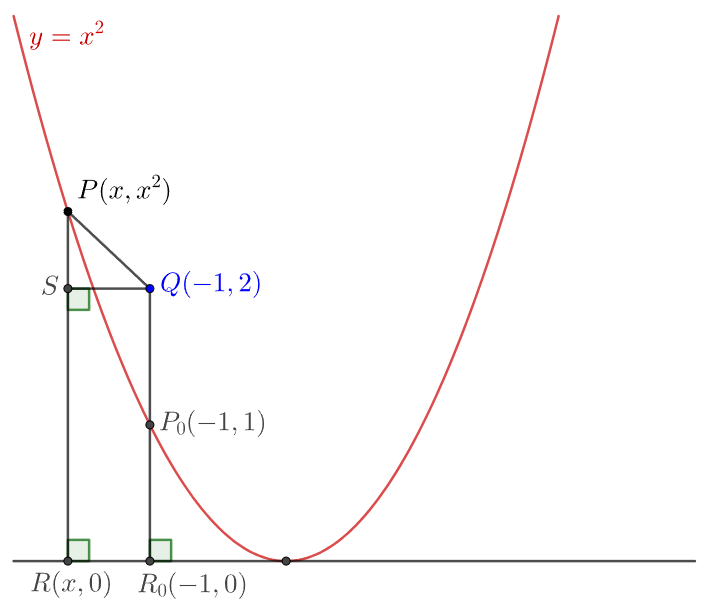 \(\begin{multline}
\shoveleft x^2+\sqrt{x^4-3x^2+2x+5}=x^2+\sqrt{(x+1)^2+(x^2-2)^2}\\
\shoveleft \text{Let }P(x, x^2) \text{ be a point on function }y=x^2, Q(-1, 2)\text{ is a fixed point}\\
\shoveleft \text{Let }R(x,0), R_0(-1,0) \text{be the perpendicular foot of }P, Q \text{ to x-axis respectively}\\
\shoveleft \text{Make }QS \perp PR, QS \cap PR=S \implies x^2+\sqrt{x^4-3x^2+2x+5}=PR+PQ\\
\shoveleft =PS+PQ+QR_0 \ge QR_0 =2 \implies (x^2+\sqrt{x^4-3x^2+2x+5})_{min}=\bbox[5px, border: 1px solid black]{2}
\end{multline}\)
\(\begin{multline}
\shoveleft x^2+\sqrt{x^4-3x^2+2x+5}=x^2+\sqrt{(x+1)^2+(x^2-2)^2}\\
\shoveleft \text{Let }P(x, x^2) \text{ be a point on function }y=x^2, Q(-1, 2)\text{ is a fixed point}\\
\shoveleft \text{Let }R(x,0), R_0(-1,0) \text{be the perpendicular foot of }P, Q \text{ to x-axis respectively}\\
\shoveleft \text{Make }QS \perp PR, QS \cap PR=S \implies x^2+\sqrt{x^4-3x^2+2x+5}=PR+PQ\\
\shoveleft =PS+PQ+QR_0 \ge QR_0 =2 \implies (x^2+\sqrt{x^4-3x^2+2x+5})_{min}=\bbox[5px, border: 1px solid black]{2}
\end{multline}\)
06/16/2026
Find the minimum value of $\dfrac{x}{2}+\sqrt{x^2-4x+7}$
Solve:
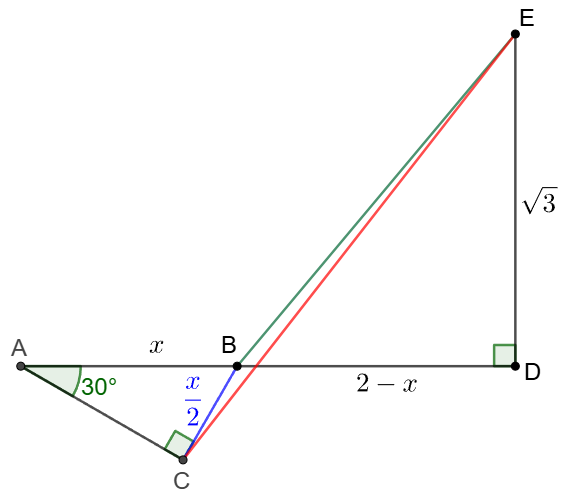 \(\begin{multline}\\
\shoveleft \dfrac{x}{2}+\sqrt{x^2-4x+7}=\dfrac{x}{2}+\sqrt{(x-2)^2+(\sqrt{3})^2}\\
\shoveleft \text{Make }AB=x, AC\perp BC, \angle{BAC}=30^{\circ}\implies BC=\dfrac{x}{2}\\
\shoveleft \text{Extend }AB \text{ to }D \text{ such that }BD=2-x, DE\perp BD, DE=\sqrt{3}\\
\shoveleft \implies AD=2 \implies \dfrac{x}{2}+\sqrt{x^2-4x+7}=BC+DE\\
\shoveleft \text{We can see that }A,C,D,E \text{ are fixed points}\\
\shoveleft \text{so } BC+DE \text{ gets minimum value when }BC+DE=CE\\
\shoveleft \implies 2-x=1\implies x=1\implies (\dfrac{x}{2}+\sqrt{x^2-4x+7})_{min}=\bbox[5px, border: 1px solid black]{\dfrac{5}{2}}
\end{multline}\)
\(\begin{multline}\\
\shoveleft \dfrac{x}{2}+\sqrt{x^2-4x+7}=\dfrac{x}{2}+\sqrt{(x-2)^2+(\sqrt{3})^2}\\
\shoveleft \text{Make }AB=x, AC\perp BC, \angle{BAC}=30^{\circ}\implies BC=\dfrac{x}{2}\\
\shoveleft \text{Extend }AB \text{ to }D \text{ such that }BD=2-x, DE\perp BD, DE=\sqrt{3}\\
\shoveleft \implies AD=2 \implies \dfrac{x}{2}+\sqrt{x^2-4x+7}=BC+DE\\
\shoveleft \text{We can see that }A,C,D,E \text{ are fixed points}\\
\shoveleft \text{so } BC+DE \text{ gets minimum value when }BC+DE=CE\\
\shoveleft \implies 2-x=1\implies x=1\implies (\dfrac{x}{2}+\sqrt{x^2-4x+7})_{min}=\bbox[5px, border: 1px solid black]{\dfrac{5}{2}}
\end{multline}\)
06/17/2026
Find the maximum value of $2\sqrt{x-1}+\sqrt{3-2x}$
Solve: \(\begin{multline} \shoveleft \text{Let }y=2\sqrt{x-1}+\sqrt{3-2x}=\sqrt{2}\sqrt{2x-2}+\sqrt{3-2x}\\ \shoveleft \text{Let }\overrightarrow{m}=(\sqrt{2},1), \overrightarrow{n}=(\sqrt{2x-2}, \sqrt{3-2x})\\ \shoveleft y=\overrightarrow{m}\cdot\overrightarrow{n}\le |\overrightarrow{m}|\cdot|\overrightarrow{n}|=\sqrt{2+1}\cdot\sqrt{2x-2+3-2x}=\sqrt{3}\\ \shoveleft \implies (2\sqrt{x-1}+\sqrt{3-2x})_{max}=\bbox[5px, border: 1px solid black]{\sqrt{3}} \end{multline}\)
06/18/2026
Find the maximum value of $5\sqrt{x-1}+\sqrt{10-2x}$
Solve: \(\begin{multline} \shoveleft \text{Let }y=5\sqrt{x-1}+\sqrt{10-2x}=5\sqrt{x-1}+\sqrt{2}\sqrt{5-x}\\ \shoveleft \text{Let }\overrightarrow{m}=(5,\sqrt{2}), \overrightarrow{n}=(\sqrt{x-1}, \sqrt{5-x})\\ \shoveleft y=\overrightarrow{m}\cdot\overrightarrow{n}\le |\overrightarrow{m}|\cdot|\overrightarrow{n}|=\sqrt{25+2}\cdot\sqrt{x-1+5-x}=6\sqrt{3}\\ \shoveleft \implies (5\sqrt{x-1}+\sqrt{10-2x})_{max}=\bbox[5px, border: 1px solid black]{6\sqrt{3}} \end{multline}\)
06/19/2026
Find the maximum value of $\sqrt{2-x}+\sqrt{8+2x}$
Solve: \(\begin{multline} \shoveleft \text{Let }y=\sqrt{2-x}+\sqrt{8+2x}=\sqrt{2-x}+\sqrt{2}\sqrt{4+x}\\ \shoveleft \text{Let }\overrightarrow{m}=(1,\sqrt{2}), \overrightarrow{n}=(\sqrt{2-x}, \sqrt{4+x})\\ \shoveleft y=\overrightarrow{m}\cdot\overrightarrow{n}\le |\overrightarrow{m}|\cdot|\overrightarrow{n}|=\sqrt{1+2}\cdot\sqrt{2-x+4+x}=3\sqrt{2}\\ \shoveleft \implies (\sqrt{2-x}+\sqrt{8+2x})_{max}=\bbox[5px, border: 1px solid black]{3\sqrt{2}} \end{multline}\)