07/04/2026
$A$ is a point on $\odot{O_1}$ and $O_1A=2r$ is the diameter of $\odot{O_2}$, $BC \perp O_1A$, $B$ is on $\odot{O_2}$, $C$ is on $\odot{O_1}$, find the maximum value of $BC$.
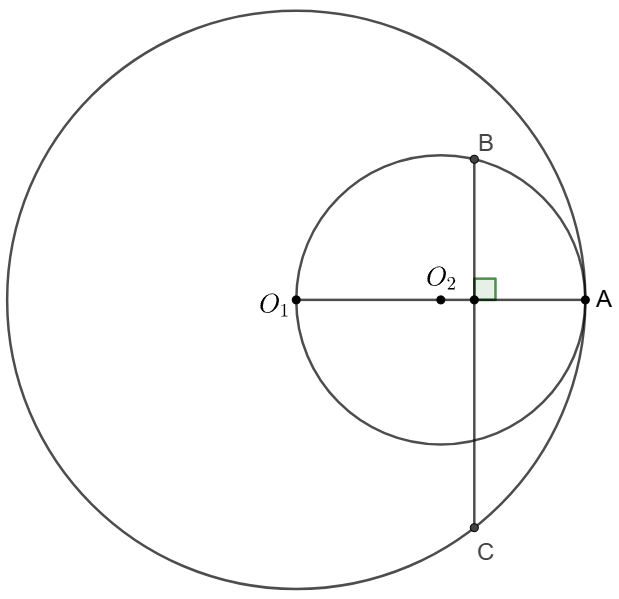
Solve:
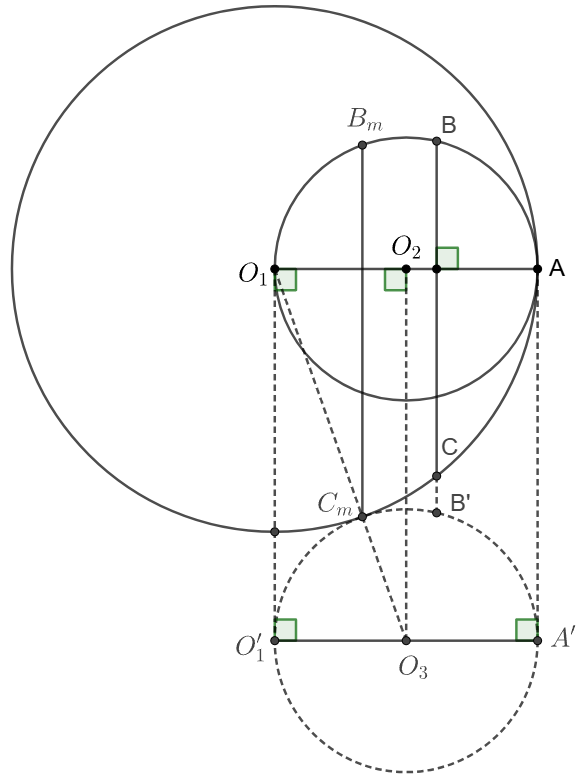 \(\begin{multline}
\shoveleft \text{Make }O_2O_3 \perp O_1A, O_1O_3=3r \text{ and the radius of } \odot{O_3}=r\\
\shoveleft \text{Let } \odot{O_1}\cap \odot{O_3}=C_m, B_mC_m \parallel BC, B_mC_m \cap \odot{O_2}=B_m\\
\shoveleft \text{Make }O_1O_1'\parallel BC \parallel AA' \text{ and }O_1', A' \text{ are on }\odot{O_3}\\
\shoveleft \text{Extend }BC \text{ to }B' \text{ such that }BC \cap \odot{O_3}=B'\\
\shoveleft \implies O_1O_1'=BB'=AA'=B_mC_m=O_2O_3=\sqrt{r^2+(3r)^2}=\sqrt{10}r\\
\shoveleft \implies B_mC_m \text{ is the maximum value of }BC=\bbox[5px, border: 1px solid black]{\sqrt{10}r}\\
\end{multline}\)
\(\begin{multline}
\shoveleft \text{Make }O_2O_3 \perp O_1A, O_1O_3=3r \text{ and the radius of } \odot{O_3}=r\\
\shoveleft \text{Let } \odot{O_1}\cap \odot{O_3}=C_m, B_mC_m \parallel BC, B_mC_m \cap \odot{O_2}=B_m\\
\shoveleft \text{Make }O_1O_1'\parallel BC \parallel AA' \text{ and }O_1', A' \text{ are on }\odot{O_3}\\
\shoveleft \text{Extend }BC \text{ to }B' \text{ such that }BC \cap \odot{O_3}=B'\\
\shoveleft \implies O_1O_1'=BB'=AA'=B_mC_m=O_2O_3=\sqrt{r^2+(3r)^2}=\sqrt{10}r\\
\shoveleft \implies B_mC_m \text{ is the maximum value of }BC=\bbox[5px, border: 1px solid black]{\sqrt{10}r}\\
\end{multline}\)
07/10/2026
Find the minimum value of $\sqrt{x^2+9}-\dfrac{x}{3}$
Solve:
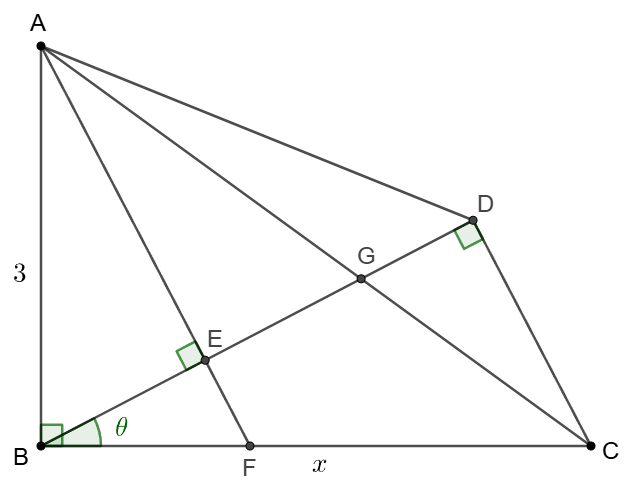 \(\begin{multline}
\shoveleft \text{Make }AB=3, BC=x, AB \perp BC \implies AC=\sqrt{x^2+9}\\
\shoveleft \text{Make }\angle{BCD}=arcsin{\dfrac{1}{3}}, BD \perp CD \implies CD=\dfrac{x}{3} \\
\shoveleft \text{Let }G=AC \cap BD, AF\perp BD, BC\cap AF = F, BD \cap AF=E\\
\shoveleft \implies \sqrt{x^2+9}-\dfrac{x}{3}=AC-CD=AG+CG-CD \ge AG \ge AE\\
\shoveleft =\sqrt{AB^2-BE^2}=\sqrt{AB^2-(\dfrac{AB}{3})^2}=\bbox[5px, border: 1px solid black]{\sqrt{2}}
\end{multline}\)
\(\begin{multline}
\shoveleft \text{Make }AB=3, BC=x, AB \perp BC \implies AC=\sqrt{x^2+9}\\
\shoveleft \text{Make }\angle{BCD}=arcsin{\dfrac{1}{3}}, BD \perp CD \implies CD=\dfrac{x}{3} \\
\shoveleft \text{Let }G=AC \cap BD, AF\perp BD, BC\cap AF = F, BD \cap AF=E\\
\shoveleft \implies \sqrt{x^2+9}-\dfrac{x}{3}=AC-CD=AG+CG-CD \ge AG \ge AE\\
\shoveleft =\sqrt{AB^2-BE^2}=\sqrt{AB^2-(\dfrac{AB}{3})^2}=\bbox[5px, border: 1px solid black]{\sqrt{2}}
\end{multline}\)
07/27/2026
One hundred passengers are lined up to board a full flight. The first passenger lost his boarding pass and decides to choose a seat randomly. Each subsequent passenger (responsible enough to not lose their boarding pass) will sit in his or her assigned seat if it is free and, otherwise, randomly choose a seat from those remaining. What is the probability that the last passenger will get to sit in his assigned seat?
Solve 1: \(\begin{multline} \shoveleft \text{Let }x \text{ be the total number of passengers}, p(x) \text{ be the probability that the }x^{th } \text{ passenger will get to site in his assigned seat}\\ \shoveleft \implies p(1)=1, p(2)=\dfrac{1}{2} * 0 +\dfrac{1}{2} * 1=\dfrac{1}{2}, p(3)=\dfrac{1}{3} * 1 + \dfrac{1}{3} * 0 + \dfrac{1}{3} * \dfrac{1}{2}=\dfrac{1}{2}\\ \shoveleft \text{Notice that if the first passenger takes the }m^{th} \text{ seat, it means the } 2^{nd} \text{ passenger to the }(k-1)^{th} \text{ passengers will take their assigned seats}\\ \shoveleft \text{This means the rest }(k-m+2) \text{ passengers will continue this process}\\ \shoveleft \text{Let's do mathematical induction on this:}\\ \shoveleft \text{Suppose for }x<=k, p(k)=\dfrac{1}{2} \implies p(k+1)=\dfrac{1}{k+1}*1+\dfrac{p(k)+p(k-1)+...+p(2)}{k+1}+\dfrac{0}{k+1}=\dfrac{1}{k+1}+\dfrac{\dfrac{k-1}{2}}{k+1}=\dfrac{1}{2} \blacksquare\\ \shoveleft \implies \text{The probability that the last passenger will get to sit in his assigned seat is }\bbox[5px, border: 1px solid black]{\dfrac{1}{2}} \\ \end{multline}\) Solve 2: \(\begin{multline} \shoveleft \text{Give a deep check on the status diagram and we will find that, for each passenger choosing a seat randomly, there are three probabilities: }\\ \shoveleft \text{(1) he chooses the first seat }\implies \text{ the last passenger will always get his assigned seat}\\ \shoveleft \text{(2) he chooses the last seat }\implies \text{ the last passenger will always miss his assigned seat}\\ \shoveleft \text{(3) he chooses a seat between the first and the last }\implies \\ \shoveleft \text{ this reduces the number of passengers and fewer passengers start repeating this process}\\ \shoveleft \implies \text{there are only two exists (1) or (2) from situation (3) and they share the same probability}\\ \shoveleft \implies \text{there are always probability of }\bbox[5px, border: 1px solid black]{\dfrac{1}{2}} \text{ that the last passenger will get to sit in his assigned seat} \end{multline}\)
07/28/2026
For $x>1$, find the minimum value of $y=x+\dfrac{4}{(x-1)^2}$
Solve: \(\begin{multline} \shoveleft \text{Let }z=x-1 \implies y=z+1+\dfrac{4}{z^2}=\dfrac{z}{2}+\dfrac{z}{2}+\dfrac{4}{z^2}+1\\ \shoveleft \ge3\sqrt[3]{\dfrac{z}{2} \dfrac{z}{2} \dfrac{4}{z^2}}+1=4 \implies y_{min}=\bbox[5px, border: 1px solid black]{4} \end{multline}\)