05/05/2026
$ABCD$ is a quadrilateral such that $\angle{ADB}=50^{\circ}$, $\angle{BDC}=30^{\circ}=\angle{ACB}$, $\angle{ACD}=40^{\circ}$, find $\angle{BAC}$
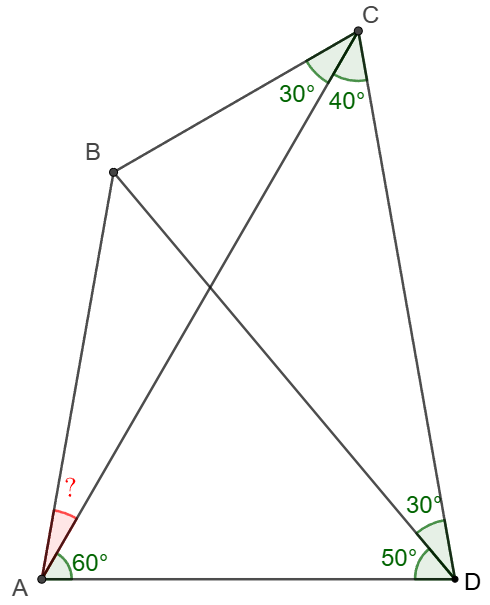
Solve:
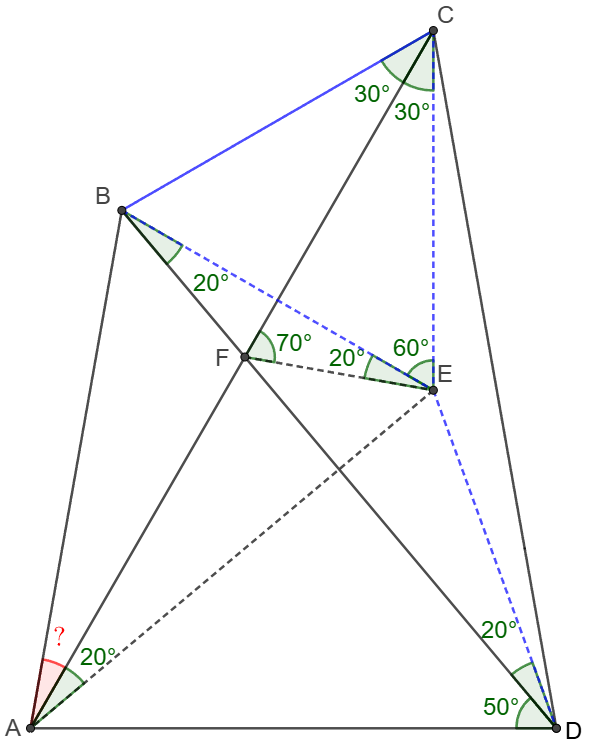 \(\begin{multline}
\shoveleft \text{Let }E \text{ be the circumcenter of }\triangle{BCD}, F=AC\cap BD\\
\shoveleft \implies EB=EC=ED, \angle{BEC}=2\angle{BCD}=60^{\circ}\\
\shoveleft \implies \triangle{BCE} \text{ is equilateral} \implies \\
\shoveleft \angle{ECF}=\angle{BCF}=30^{\circ}, \angle{DBE}=\angle{BDE}=20^{\circ} \implies \angle{ADE}=70^{\circ}\\
\shoveleft \implies \triangle{ABC}\cong\triangle{AEC},\triangle{BCF}\cong\triangle{ECF}\implies \angle{BAC}=\angle{EAC},BF=EF\\
\shoveleft \implies \angle{CFE}=180^{\circ}-30^{\circ}-60^{\circ}-20^{\circ}=70^{\circ}=\angle{ADE}\\
\shoveleft \implies ADEF \text{ is cyclic}\implies \angle{EAC}=\angle{BDE}=20^{\circ}\implies \angle{BAC}=\bbox[5px, border: 1px solid black]{20^{\circ}}
\end{multline}\)
\(\begin{multline}
\shoveleft \text{Let }E \text{ be the circumcenter of }\triangle{BCD}, F=AC\cap BD\\
\shoveleft \implies EB=EC=ED, \angle{BEC}=2\angle{BCD}=60^{\circ}\\
\shoveleft \implies \triangle{BCE} \text{ is equilateral} \implies \\
\shoveleft \angle{ECF}=\angle{BCF}=30^{\circ}, \angle{DBE}=\angle{BDE}=20^{\circ} \implies \angle{ADE}=70^{\circ}\\
\shoveleft \implies \triangle{ABC}\cong\triangle{AEC},\triangle{BCF}\cong\triangle{ECF}\implies \angle{BAC}=\angle{EAC},BF=EF\\
\shoveleft \implies \angle{CFE}=180^{\circ}-30^{\circ}-60^{\circ}-20^{\circ}=70^{\circ}=\angle{ADE}\\
\shoveleft \implies ADEF \text{ is cyclic}\implies \angle{EAC}=\angle{BDE}=20^{\circ}\implies \angle{BAC}=\bbox[5px, border: 1px solid black]{20^{\circ}}
\end{multline}\)
05/15/2026
$D$ is the midpoint of side $AC$ of $\triangle{ABC}$, and $\angle{ADB}=45^{\circ}$, $\angle{ACB}=30^{\circ}$, find $\angle{BAC}$
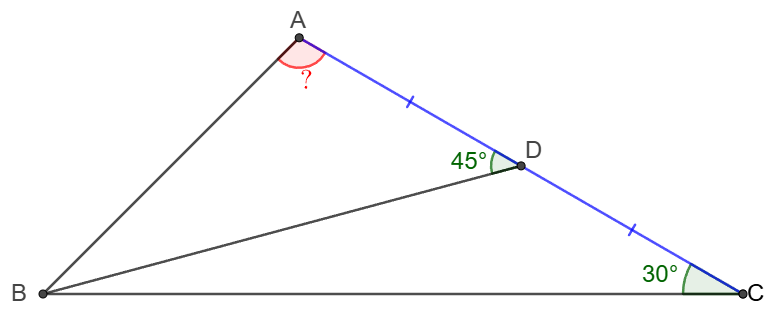
Solve:
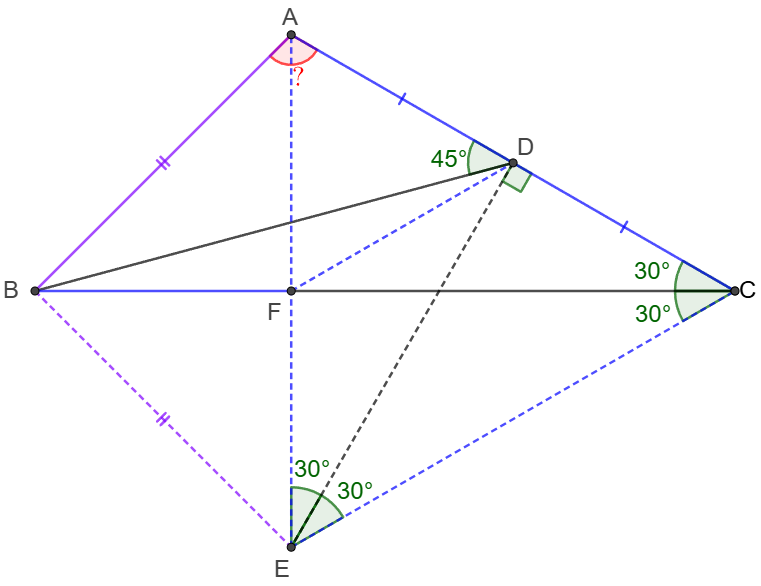
05/16/2026
$B,C$ are on line $AD$ such that $\dfrac{AB}{BC}=\dfrac{AD}{CD}=k \ne 1$, $M$ is a point on the circle whose diameter is $BD$. Show that $\dfrac{AM}{MC}=k$
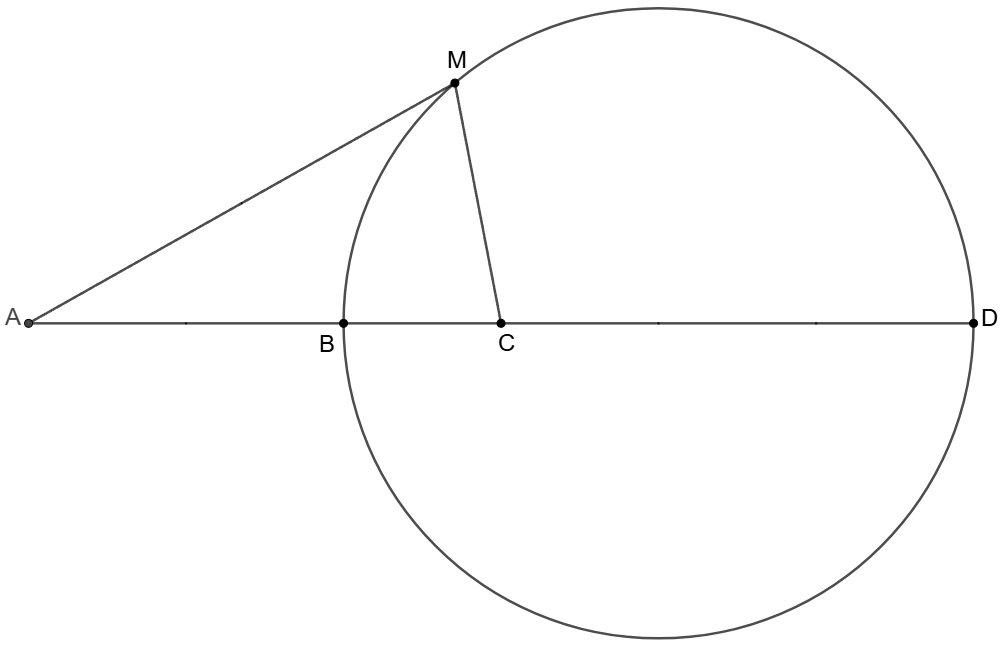
Prove 1:
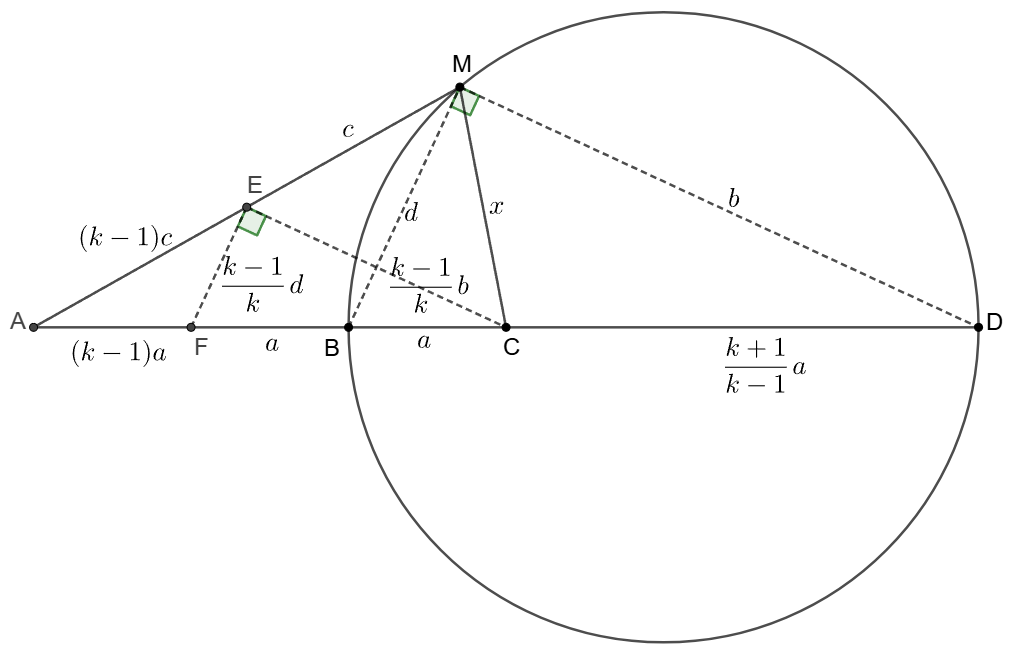 \(\begin{multline}
\shoveleft \text{Let }E \text{ on }AM \text{ such that }CE \parallel DM\\
\shoveleft \text{Let }F \text{ on }AB \text{ such that }EF \parallel MB\\
\shoveleft \text{Let }BC=a, DM=b, EM=c, BM=d, CM=x\\
\shoveleft \dfrac{AB}{a}=\dfrac{AB+a+CD}{CD}=k\implies AB=ka, CD=\dfrac{k+1}{k-1}a\\
\shoveleft \dfrac{AC}{CD}=k-1=\dfrac{AE}{c}\implies AE=(k-1)c\\
\shoveleft \dfrac{AE}{EM}=\dfrac{AF}{FB}=k-1, AF+FB=ka\implies AF=(k-1)a, FB=a\\
\shoveleft \dfrac{AE}{AM}=\dfrac{EF}{d}\implies EF=\dfrac{k-1}{k}d\\
\shoveleft \dfrac{AE}{AM}=\dfrac{EC}{b}\implies EC=\dfrac{k-1}{k}b\\
\shoveleft BD\text{ is the diameter }\implies BM\perp MD\implies \\
\shoveleft b^2+d^2=(1+\dfrac{k+1}{k-1})^2a^2=\dfrac{4k^2}{(k-1)^2}a^2 \implies d^2=\dfrac{4k^2}{(k-1)^2}a^2-b^2\\
\shoveleft \text{Apply Stewart's theorem on }\triangle{ACE} \text{ and }EF \implies\\
\shoveleft \dfrac{(k-1)^2}{k^2}b^2+2(k-1)c^2=\dfrac{(k^2-1)}{k^2}d^2+2(k+1)a^2\\
\shoveleft \implies \dfrac{k-1}{k}b^2+(k-1)c^2=\dfrac{(k+1)^2}{k-1}a^2\\
\shoveleft \text{Apply Stewart's theorem on }\triangle{ADM} \text{ and }CM \implies\\
\shoveleft (k+1)ab^2+\dfrac{k+1}{k-1}ak^2c^2=(k+1+\dfrac{k+1}{k-1})a(x^2+\dfrac{(k+1^2)}{k-1}a^2)\\
\shoveleft \implies x^2=\dfrac{k-1}{k}b^2+kc^2-\dfrac{(k+1)^2}{k-1}a^2=c^2\implies x=c \implies \dfrac{AM}{MC}=k\blacksquare\\
\end{multline}\)
Prove 2:
\(\begin{multline}
\shoveleft \text{Let }E \text{ on }AM \text{ such that }CE \parallel DM\\
\shoveleft \text{Let }F \text{ on }AB \text{ such that }EF \parallel MB\\
\shoveleft \text{Let }BC=a, DM=b, EM=c, BM=d, CM=x\\
\shoveleft \dfrac{AB}{a}=\dfrac{AB+a+CD}{CD}=k\implies AB=ka, CD=\dfrac{k+1}{k-1}a\\
\shoveleft \dfrac{AC}{CD}=k-1=\dfrac{AE}{c}\implies AE=(k-1)c\\
\shoveleft \dfrac{AE}{EM}=\dfrac{AF}{FB}=k-1, AF+FB=ka\implies AF=(k-1)a, FB=a\\
\shoveleft \dfrac{AE}{AM}=\dfrac{EF}{d}\implies EF=\dfrac{k-1}{k}d\\
\shoveleft \dfrac{AE}{AM}=\dfrac{EC}{b}\implies EC=\dfrac{k-1}{k}b\\
\shoveleft BD\text{ is the diameter }\implies BM\perp MD\implies \\
\shoveleft b^2+d^2=(1+\dfrac{k+1}{k-1})^2a^2=\dfrac{4k^2}{(k-1)^2}a^2 \implies d^2=\dfrac{4k^2}{(k-1)^2}a^2-b^2\\
\shoveleft \text{Apply Stewart's theorem on }\triangle{ACE} \text{ and }EF \implies\\
\shoveleft \dfrac{(k-1)^2}{k^2}b^2+2(k-1)c^2=\dfrac{(k^2-1)}{k^2}d^2+2(k+1)a^2\\
\shoveleft \implies \dfrac{k-1}{k}b^2+(k-1)c^2=\dfrac{(k+1)^2}{k-1}a^2\\
\shoveleft \text{Apply Stewart's theorem on }\triangle{ADM} \text{ and }CM \implies\\
\shoveleft (k+1)ab^2+\dfrac{k+1}{k-1}ak^2c^2=(k+1+\dfrac{k+1}{k-1})a(x^2+\dfrac{(k+1^2)}{k-1}a^2)\\
\shoveleft \implies x^2=\dfrac{k-1}{k}b^2+kc^2-\dfrac{(k+1)^2}{k-1}a^2=c^2\implies x=c \implies \dfrac{AM}{MC}=k\blacksquare\\
\end{multline}\)
Prove 2:
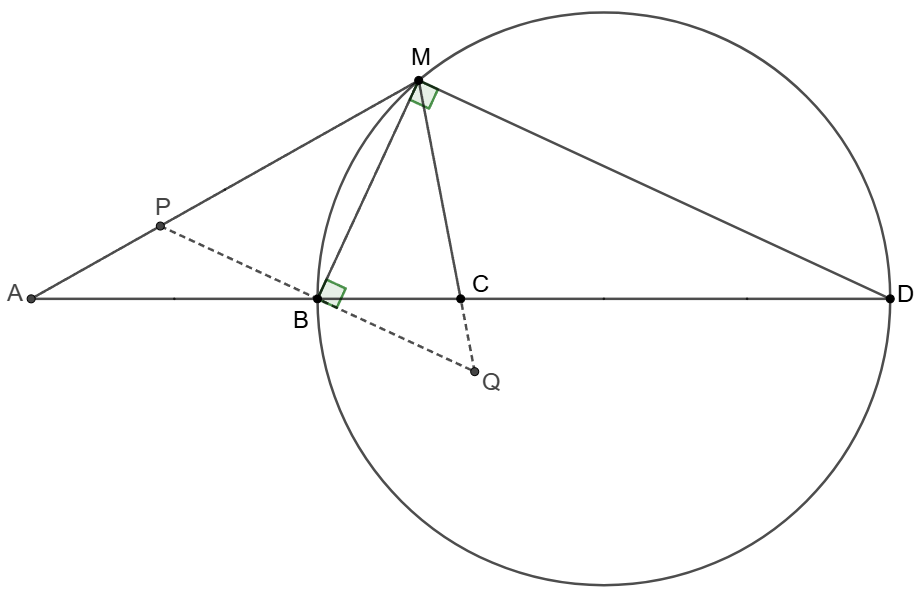 \(\begin{multline}
\shoveleft \text{Make }PQ \perp BM \text{ such that }B \in PQ, AM\cap PQ=P, CM\cap PQ=Q \implies \\
\shoveleft \text{(1) }\triangle{BCQ}\sim\triangle{DCM}\implies\dfrac{BC}{CD}=\dfrac{BQ}{MD}\implies BQ=\dfrac{BC}{CD}MD\\
\shoveleft \text{(2) }\triangle{ABP}\sim\triangle{ADM}\implies\dfrac{AB}{AD}=\dfrac{PB}{MD}\implies PB=\dfrac{AB}{AD}MD\\
\shoveleft \dfrac{AB}{BC}=\dfrac{AD}{CD}=k \implies \dfrac{BC}{CD}=\dfrac{AB}{AD}\implies PB=BQ\implies \triangle{MPB}\cong\triangle{MQB}\\
\shoveleft \implies \angle{AMB}=\angle{CMB}\implies \dfrac{AM}{MC}=\dfrac{AB}{BC}=k\blacksquare
\end{multline}\)
Prove 3:
\(\begin{multline}
\shoveleft \text{Make }PQ \perp BM \text{ such that }B \in PQ, AM\cap PQ=P, CM\cap PQ=Q \implies \\
\shoveleft \text{(1) }\triangle{BCQ}\sim\triangle{DCM}\implies\dfrac{BC}{CD}=\dfrac{BQ}{MD}\implies BQ=\dfrac{BC}{CD}MD\\
\shoveleft \text{(2) }\triangle{ABP}\sim\triangle{ADM}\implies\dfrac{AB}{AD}=\dfrac{PB}{MD}\implies PB=\dfrac{AB}{AD}MD\\
\shoveleft \dfrac{AB}{BC}=\dfrac{AD}{CD}=k \implies \dfrac{BC}{CD}=\dfrac{AB}{AD}\implies PB=BQ\implies \triangle{MPB}\cong\triangle{MQB}\\
\shoveleft \implies \angle{AMB}=\angle{CMB}\implies \dfrac{AM}{MC}=\dfrac{AB}{BC}=k\blacksquare
\end{multline}\)
Prove 3:
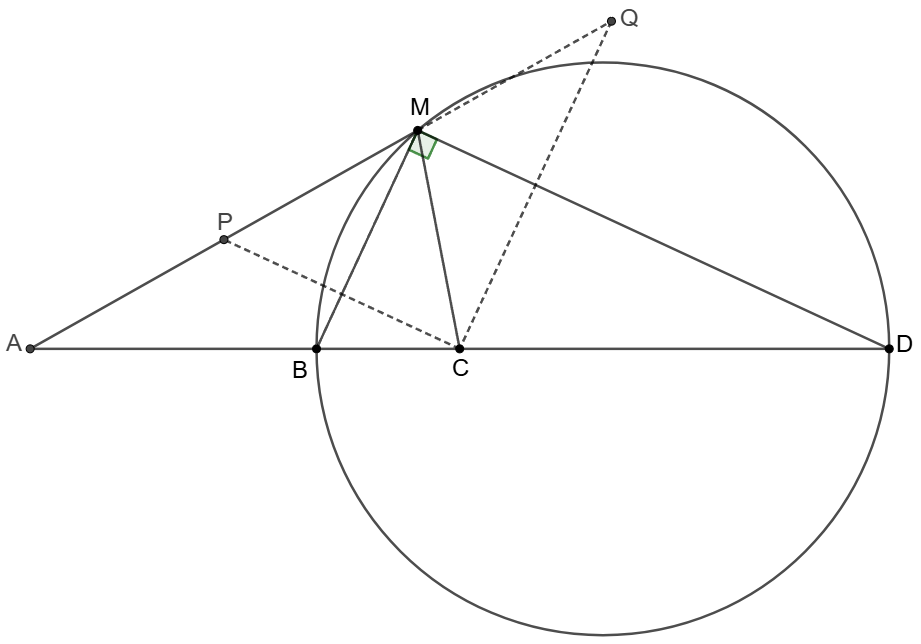 \(\begin{multline}
\shoveleft \text{Make }CP \parallel DM \text{ and } AM\cap CP=P, CQ\parallel BM \text{ and } AM \cap CQ=Q\\
\shoveleft \implies \dfrac{PM}{AM}=\dfrac{CD}{AD}, \dfrac{QM}{AM}=\dfrac{BC}{AB}\implies PM=\dfrac{CD}{AD}AM, QM=\dfrac{BC}{AB}AM\\
\shoveleft \dfrac{AB}{BC}=\dfrac{AD}{CD}=k \implies PM=QM\\
\shoveleft \angle{PCQ}=\angle{BMD}=90^{\circ}\implies M \text{ is the circumcenter of }\triangle{PCQ}\\
\shoveleft \implies QM=MC\implies \dfrac{AM}{MC}=\dfrac{AM}{QM}=\dfrac{AB}{BC}=k\blacksquare
\end{multline}\)
Note:
\(\begin{multline}
\shoveleft \text{Make }CP \parallel DM \text{ and } AM\cap CP=P, CQ\parallel BM \text{ and } AM \cap CQ=Q\\
\shoveleft \implies \dfrac{PM}{AM}=\dfrac{CD}{AD}, \dfrac{QM}{AM}=\dfrac{BC}{AB}\implies PM=\dfrac{CD}{AD}AM, QM=\dfrac{BC}{AB}AM\\
\shoveleft \dfrac{AB}{BC}=\dfrac{AD}{CD}=k \implies PM=QM\\
\shoveleft \angle{PCQ}=\angle{BMD}=90^{\circ}\implies M \text{ is the circumcenter of }\triangle{PCQ}\\
\shoveleft \implies QM=MC\implies \dfrac{AM}{MC}=\dfrac{AM}{QM}=\dfrac{AB}{BC}=k\blacksquare
\end{multline}\)
Note:
- The circle $(BDM)$ is the Apollonian Circle, which is the locus of points $M$ satisfying $\dfrac{AM}{MC}=k \ne 1$
- The circle $(BDM)$ inverts $A$ into $C$
- Any two of the following conditions implies the third condition (illustrated in EGMO by Evan Chen):
- $(A, C; B, D)$ is a harmonic bundle (which means $\dfrac{AB}{CB} \cdot \dfrac{CD}{AD}=-1$, $-1$ means $\overline{AC}$ and $\overline{BD}$ intersect)
- $M$ is a point not on the line and $\angle{BMD}=90^{\circ}$
- $BM$ bisects $\angle{AMC}$
05/22/2026
$AC$ and $BD$ are two mutually perpendicular chords of a circle. $AB=6$, $CD=8$, find the radius of the circle.
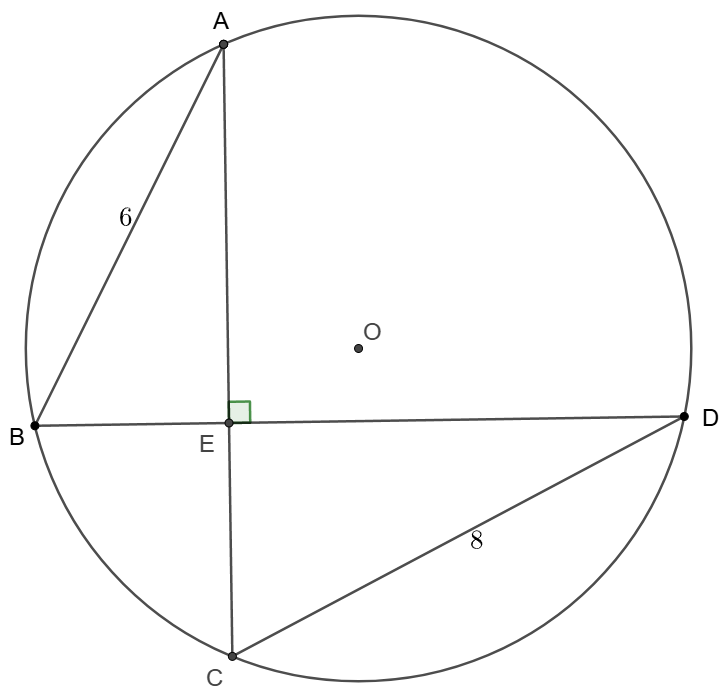
Solve 1:
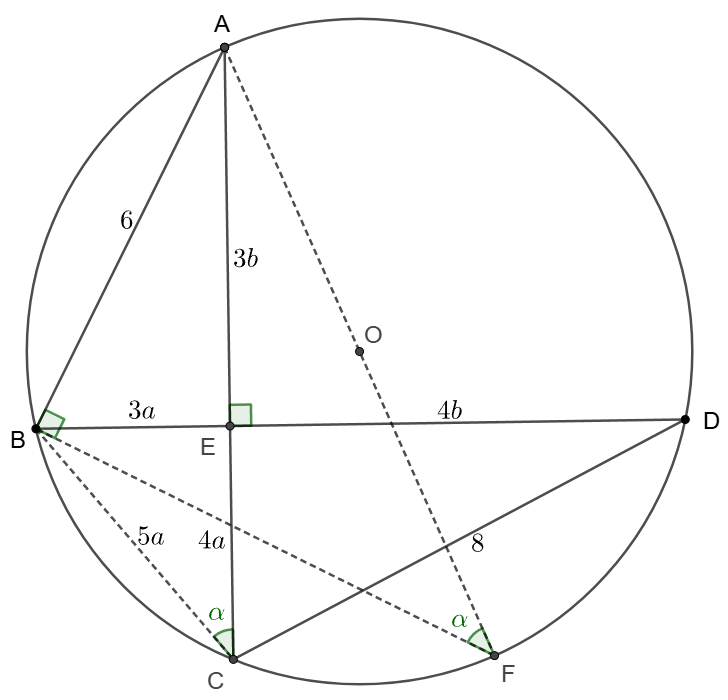 \(\begin{multline}
\shoveleft \text{Easy to know }\triangle{ABE}\sim \triangle{DCE}, \text{Let }BE=3a,AE=3b \\
\shoveleft \implies CE=4a,DE=4b \implies BC=5a\\
\shoveleft \text{Let }AF\text{ be the diameter of the circle } \implies \angle{ACB}=\angle{AFB}\\
\shoveleft \implies sin\angle{ACB}=\dfrac{3}{5}=sin\angle{AFB}=\dfrac{6}{2R}\implies R=\bbox[5px, border: 1px solid black]{5}
\end{multline}\)
Solve 2:
\(\begin{multline}
\text {According to the }\href{https://math.stackexchange.com/questions/1481891/ab-and-cd-are-two-mutually-perpendicular-chords-of-a-circle-of-radius-r-i}{\text{anonymous theorem about two orthogonal chords}}\\
\shoveleft \implies AE^2+BE^2+CE^2+DE^2=4R^2\implies R=\sqrt{\dfrac{6^2+8^2}{4}}=\bbox[5px, border: 1px solid black]{5}
\end{multline}\)
\(\begin{multline}
\shoveleft \text{Easy to know }\triangle{ABE}\sim \triangle{DCE}, \text{Let }BE=3a,AE=3b \\
\shoveleft \implies CE=4a,DE=4b \implies BC=5a\\
\shoveleft \text{Let }AF\text{ be the diameter of the circle } \implies \angle{ACB}=\angle{AFB}\\
\shoveleft \implies sin\angle{ACB}=\dfrac{3}{5}=sin\angle{AFB}=\dfrac{6}{2R}\implies R=\bbox[5px, border: 1px solid black]{5}
\end{multline}\)
Solve 2:
\(\begin{multline}
\text {According to the }\href{https://math.stackexchange.com/questions/1481891/ab-and-cd-are-two-mutually-perpendicular-chords-of-a-circle-of-radius-r-i}{\text{anonymous theorem about two orthogonal chords}}\\
\shoveleft \implies AE^2+BE^2+CE^2+DE^2=4R^2\implies R=\sqrt{\dfrac{6^2+8^2}{4}}=\bbox[5px, border: 1px solid black]{5}
\end{multline}\)
05/24/2026
$ABCD$ is a quadrilateral such that $\angle{ACB}=12^{\circ}$, $\angle{ACD}=57^{\circ}$, $\angle{ADB}=18^{\circ}$, $\angle{BDC}=30^{\circ}$, find $\angle{BAC}$
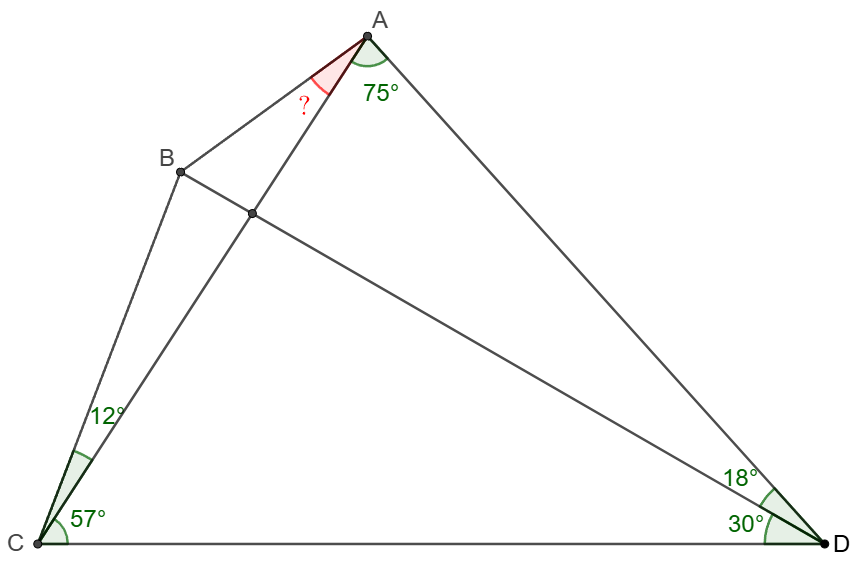
Solve:
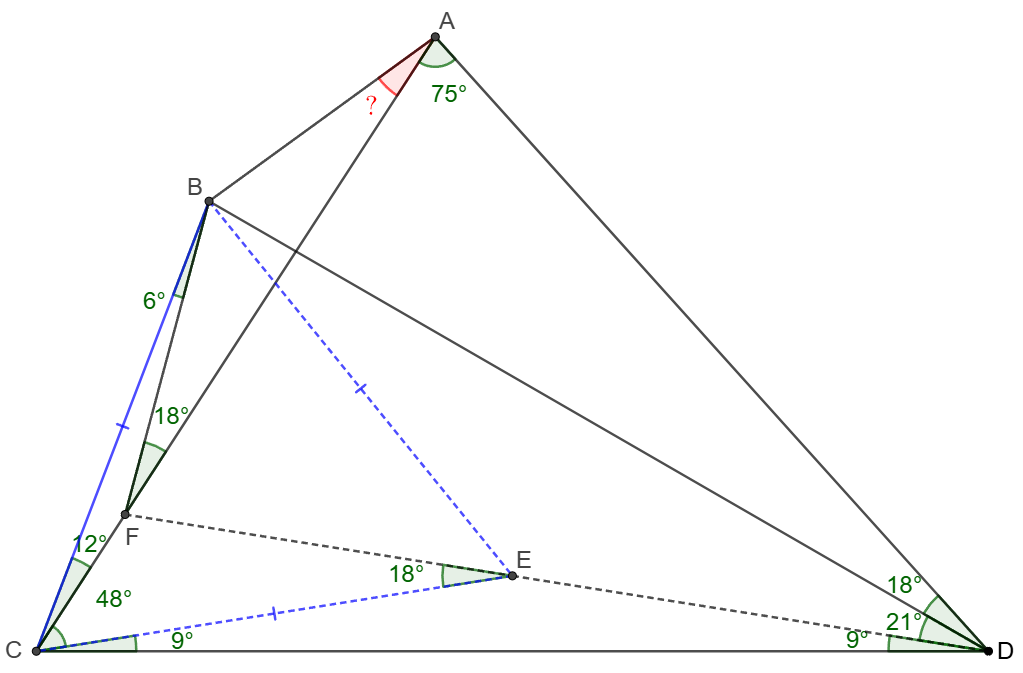 \(\begin{multline}
\shoveleft \text{Let }E \text{ be the circumcenter of }\triangle{BCD} \implies \\
\shoveleft BE=CE=BC, \angle{BEC}=2\angle{BDC}=60^{\circ}\\
\shoveleft \implies \triangle{BCE} \text{ is equilateral }\implies \angle{BCE}=60^{\circ}\\
\shoveleft \implies \angle{DCE}=9^{\circ}=\angle{EDC}\implies \angle{BDF}=21^{\circ},\angle{CEF}=18^{\circ}\\
\shoveleft \text{For this construction of equilateral triangle we proved }\href{https://mathwo.github.io/2024/05/01/wo/#05142024}{\text{HERE}}\\
\shoveleft \implies \angle{CBF}=6^{\circ}\implies \angle{BFA}=18^{\circ}=\angle{ADB}\\
\shoveleft \implies ABFD \text{ is cyclic}\implies \angle{BAC}=\angle{BDF}=\bbox[5px, border: 1px solid black]{21^{\circ}}
\end{multline}\)
\(\begin{multline}
\shoveleft \text{Let }E \text{ be the circumcenter of }\triangle{BCD} \implies \\
\shoveleft BE=CE=BC, \angle{BEC}=2\angle{BDC}=60^{\circ}\\
\shoveleft \implies \triangle{BCE} \text{ is equilateral }\implies \angle{BCE}=60^{\circ}\\
\shoveleft \implies \angle{DCE}=9^{\circ}=\angle{EDC}\implies \angle{BDF}=21^{\circ},\angle{CEF}=18^{\circ}\\
\shoveleft \text{For this construction of equilateral triangle we proved }\href{https://mathwo.github.io/2024/05/01/wo/#05142024}{\text{HERE}}\\
\shoveleft \implies \angle{CBF}=6^{\circ}\implies \angle{BFA}=18^{\circ}=\angle{ADB}\\
\shoveleft \implies ABFD \text{ is cyclic}\implies \angle{BAC}=\angle{BDF}=\bbox[5px, border: 1px solid black]{21^{\circ}}
\end{multline}\)
05/31/2026
$D$ is a point on side $BC$ of $\triangle{ABC}$ such that $\angle{ACB}=30^{\circ}$, $\angle{DAC}=10^{\circ}$, $\angle{BAD}=40^{\circ}$, prove that $AD=BC$
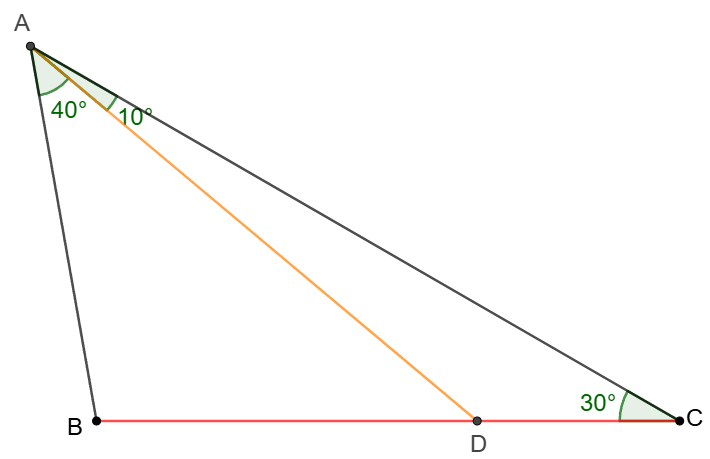
Prove:
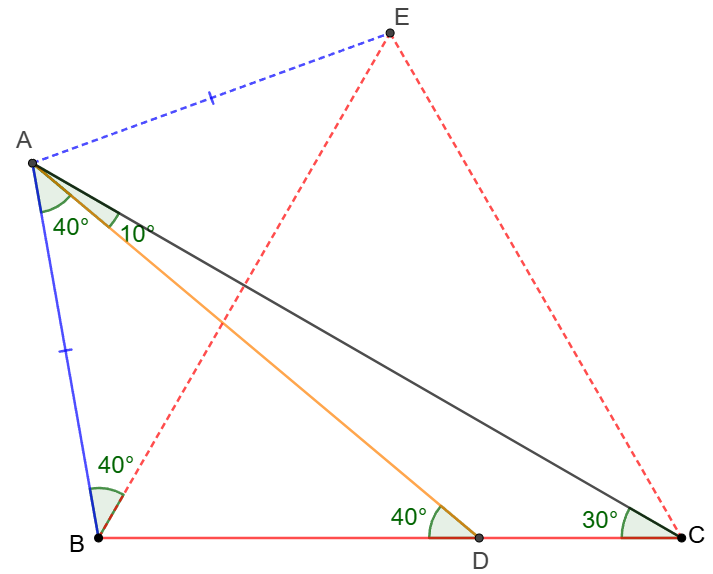 \(\begin{multline}
\shoveleft \text{Easy to see }\angle{ABC}=100^{\circ}, \angle{ADB}=40^{\circ}=\angle{BAD}\implies AB=BD\\
\shoveleft \text{Make equilateral triangle }\triangle{BCE} \text{ such that }E \text{ is on the other side of }AC \text{ to }B\\
\shoveleft \implies \angle{EBC}=\angle{ACB}=60^{\circ}\implies \angle{ACB}=30^{\circ} \implies \triangle{ABC}\cong\triangle{AEC}\\
\shoveleft \implies AB=AE=BD, \angle{BAC}=\angle{EAC} \implies \angle{BAE}=100^{\circ}=\angle{ABD}\\
\shoveleft \implies \triangle{BAE}\cong\triangle{ABD}\implies AD=BE=BC\blacksquare
\end{multline}\)
\(\begin{multline}
\shoveleft \text{Easy to see }\angle{ABC}=100^{\circ}, \angle{ADB}=40^{\circ}=\angle{BAD}\implies AB=BD\\
\shoveleft \text{Make equilateral triangle }\triangle{BCE} \text{ such that }E \text{ is on the other side of }AC \text{ to }B\\
\shoveleft \implies \angle{EBC}=\angle{ACB}=60^{\circ}\implies \angle{ACB}=30^{\circ} \implies \triangle{ABC}\cong\triangle{AEC}\\
\shoveleft \implies AB=AE=BD, \angle{BAC}=\angle{EAC} \implies \angle{BAE}=100^{\circ}=\angle{ABD}\\
\shoveleft \implies \triangle{BAE}\cong\triangle{ABD}\implies AD=BE=BC\blacksquare
\end{multline}\)