2026/10/01
$AB$ is the diameter of semicircle, and $AB=20$. There are two squares inscribed inside the semicircle. Find the sum of the area of two squares $S_1 + S_2$.
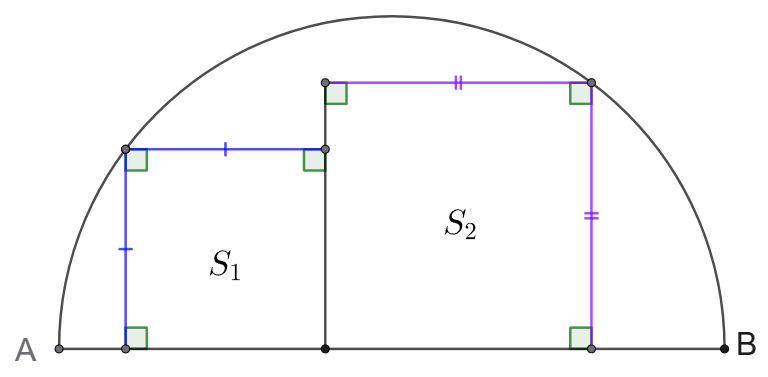
Solve:
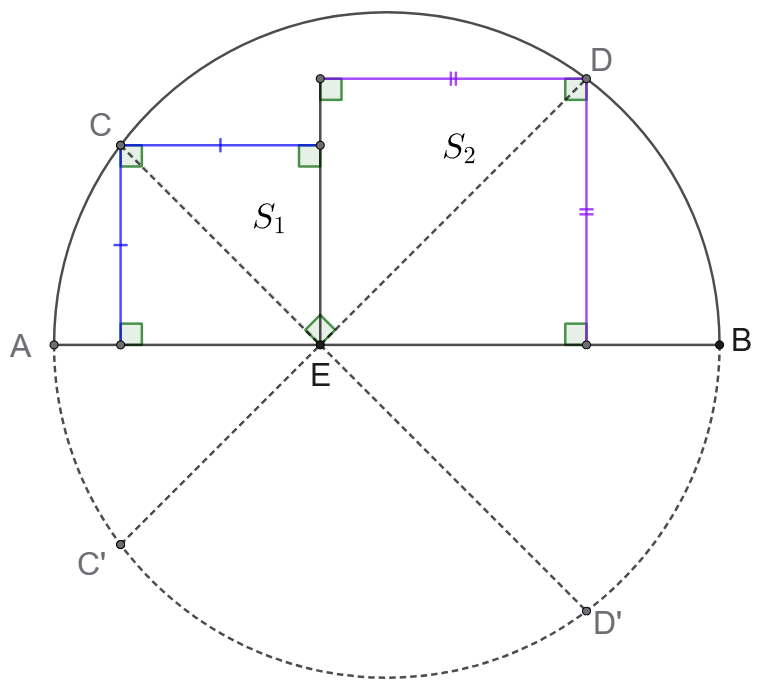 \(\begin{multline}
\shoveleft \text{Let points }C, D \text{ to be the intersect of the squares and the semicircle}\\
\shoveleft \text{Let points }C', D' \text{ to be their reflection along }AB, E \text{ to be their shared point on }AB\\
\shoveleft \text{Let the side length of the squares to be }a, b \implies S_1=a^2, S_2=b^2\\
\shoveleft \text{Easy to see that }CE \perp DE, CE \perp C'E \implies C', E, D \text{ are collinear}\\
\shoveleft \text{Similarly, }C,E,D' \text{ are collinear} \implies CD', C'D \text{ are orthogonal chords}\\
\shoveleft \implies CE^2+ED^2+C'E^2+D'E^2=AB^2 (\href{https://en.wikipedia.org/wiki/Perpendicular#cite_note-4}{\text{According to Anonymous Theory}})\\
\shoveleft \implies 2*(\sqrt{2}a)^2+2*(\sqrt{b})^2=20^2\implies S_1+S_2=a^2+b^2=\bbox[5px, border: 1px solid black]{100}
\end{multline}\)
2026/10/02
$P$ is a point inside square $ABCD$ such that $PA=P_a, PB=P_b, PD=P_d$, find the area of the square.
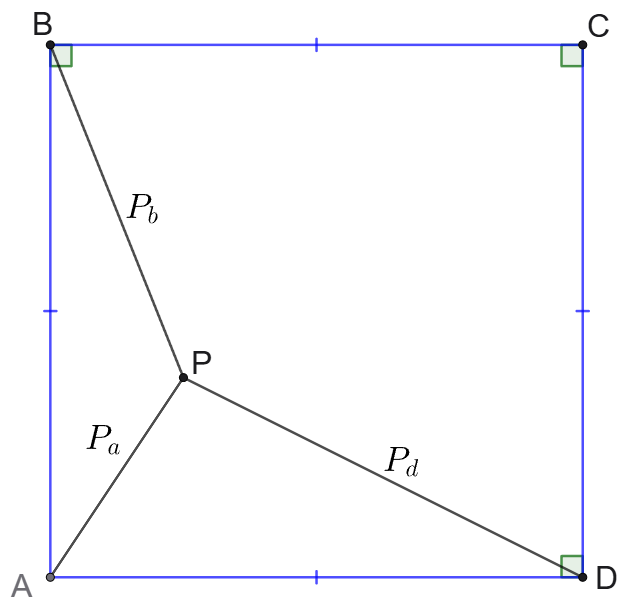
Solve: \(\begin{multline} \shoveleft \text{Let }AB=AD=a\implies\\ \shoveleft cos\angle{BAP}=\dfrac{a^2+P_a^2-P_b^2}{2P_aa}, cos\angle{DAP}=\dfrac{a^2+P_a^2-P_d^2}{2P_aa}\\ \shoveleft \angle{BAP}=90^{\circ}-\angle{DAP}\implies cos\angle{BAP}=sin\angle{DAP}\\ \shoveleft \implies 1=cos^2\angle{DAP}+sin^2\angle{DAP}=cos^2\angle{DAP}+cos^2\angle{BAP}\\ \shoveleft \implies (a^2+P_a^2-P_b^2)^2+(a^2+P_a^2-P_d^2)^2=4P_a^2a^2\\ \shoveleft \implies 2a^4-2(P_b^2+P_d^2)a^2+(P_a^2-P_b^2)^2+(P_a^2-P_d^2)^2=0\\ \shoveleft \implies a^2=\bbox[5px, border: 1px solid black]{\dfrac{P_b^2+P_d^2\pm\sqrt{(P_b^2+P_d^2)^2-2(P_a^2-P_b^2)^2-2(P_a^2-P_d^2)^2}}{2}}\\ \end{multline}\)
2026/10/05
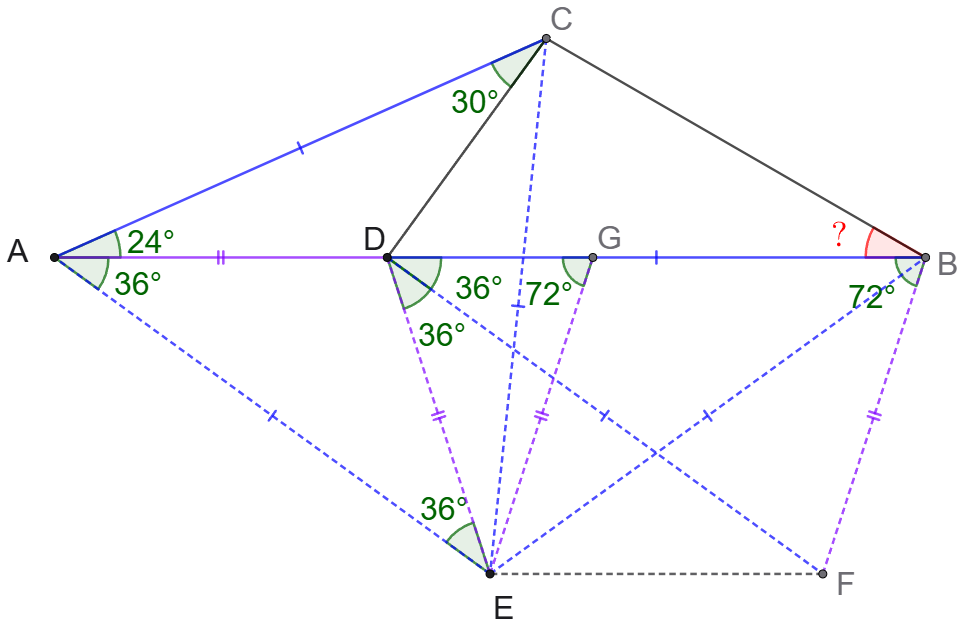
$\angle{CAB}=24^{\circ}$,$D$ is a point on side $AB$ of $\triangle{ABC}$ such that $\angle{ACD}=30^{\circ}$, $AC=BD$, find $\angle{ABC}$
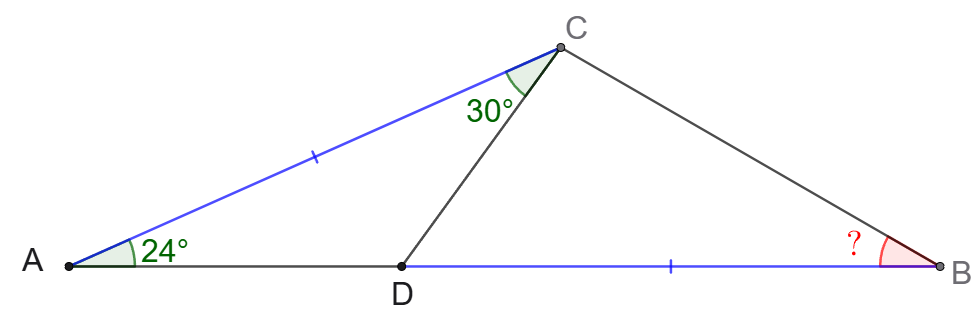
Solve:
 \(\begin{multline}
\shoveleft \text{Let }E \text{ be the reflection of point } A \text{ along }CD \implies AC=EC, \angle{ACD}=\angle{ECD}=30^{\circ}\\
\shoveleft \implies \triangle{ACE} \text{ is equilateral} \implies AD=ED, AE=AC=CE,\angle{EAD}=\angle{AED}=36^{\circ}\\
\shoveleft \text{Make }DF\parallel AE, EF\parallel AD, DF\cap EF=F, \text{ make }EG\parallel BF, EG\cap AB=G\\
\shoveleft \implies AEFD, EFBG \text{ are parallelograms }\implies AE=DF=DB, \angle{FDB}=36^{\circ}\\
\shoveleft \implies \angle{DBF}=72^{\circ}=\angle{BDE}=\angle{DGE}\implies DE=GE=BF\implies \triangle{BDE}\cong\triangle{DBF}\\
\shoveleft \implies DF=BE=CE=AE\implies E\text{ is the circumcenter of }\triangle{ABC}\\
\shoveleft \implies \angle{ABC}=\dfrac{\angle{AEC}}{2}=\bbox[5px, border: 1px solid black]{30^{\circ}}
\end{multline}\)
2026/10/10
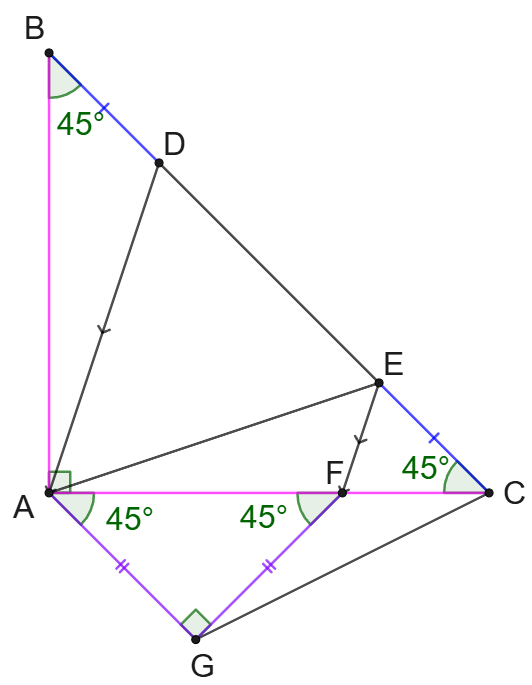
$\triangle{ABC}$, $\triangle{AFG}$ are isosceles right angle triangles with their hypotenuse $BC$, $AF$ respectively. $G$ is outside of $\triangle{ABC}$, $F$ is on $BC$. $D, E$ are two points on $BC$ such that $EF \parallel AD$, $BD=CE$, show that $\sqrt{2}CG=AD+EF$
Prove:
 \(\begin{multline}
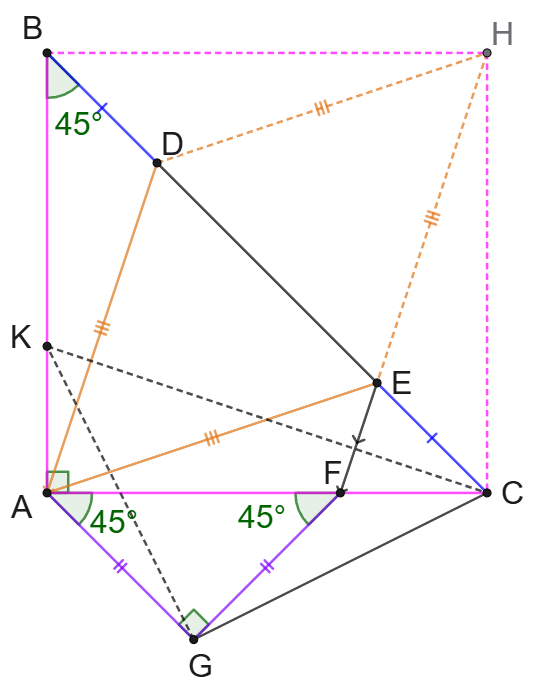
\shoveleft BD=CE AB=AC, \angle{ABD}=\angle{ACE}\implies \triangle{ABD}\cong\triangle{ACE}\implies AD=AE\\
\shoveleft \text{Extend }FE \text{ to }H \text{ such that }DH \parallel AE \implies AEHD \text{ is a rhombus}\\
\shoveleft \implies AE=DH=AD=HE, \angle{ADB}=\angle{CDH}\implies \triangle{ABD}\cong\triangle{HBD}\\
\shoveleft \implies AB=HB=AC=HC \implies ABHC \text{ is a square}\\
\shoveleft \text{Make }CK\perp FH, CK\cap AB=K \implies \triangle{ACK}\cong\triangle{CHF}\\
\shoveleft \implies AK=CF, CK=HF=AE+EF=AD+EF\\
\shoveleft \angle{KAG}=135^{\circ}=\angle{CFG}, AG=GF \implies \triangle{KAG}\cong\triangle{CFG}\\
\shoveleft \implies KG=CG, \angle{KGA}=\angle{CGF}\implies \angle{CGK}=\angle{AGF}=90^{\circ}\\
\shoveleft \implies \triangle{CGK}\text{ is also an isosceles right angle triangle} \implies \sqrt{2}CG=AD+EF\blacksquare
\end{multline}\)
2026/10/14
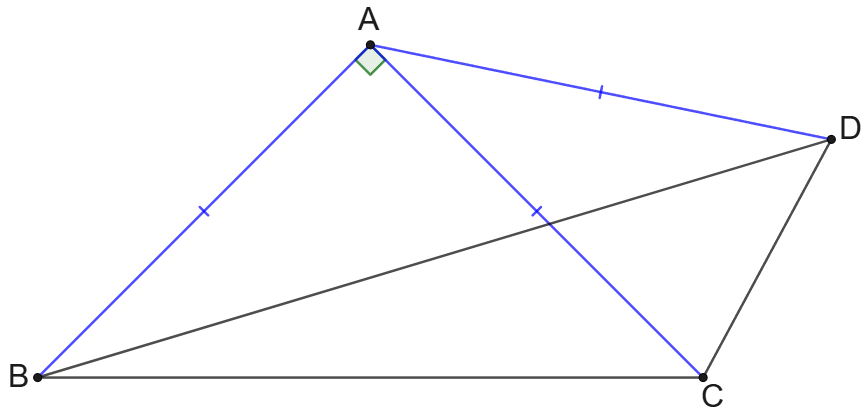
$ABCD$ is an quadrilateral such that $AB=AC=AD$, $\angle{BAC}=90^{\circ}$, $BD=a$, find $[ABCD]$
Solve:
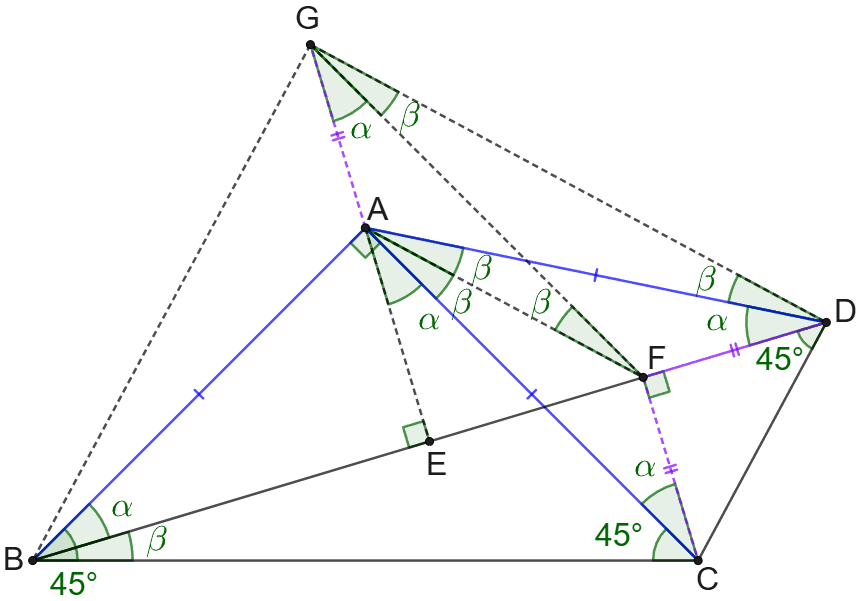 \(\begin{multline}
\shoveleft \text{Easy to see that }\angle{ABC}=\angle{ACB}=\angle{BDC}=45^{\circ}\\
\shoveleft \text{Let }AE\perp BD, CF\perp BD, AE\cap BD=E, CF\cap BD=F\\
\shoveleft \text{Make }FG\parallel AC \text{ and } EA\cap FG=G, \text{Let }\angle{ABD}=\alpha, \angle{CBD}=\beta\\
\shoveleft \implies CF=AG=DF, \angle{EAC}=\angle{FCA}=\angle{ABD}=\angle{EGF}=\angle{ADB}=\alpha\\
\shoveleft \implies \triangle{ACF}\cong \triangle{ADF}, ABCF \text{ are cyclic}, AFDG \text{ are cyclic}\\
\shoveleft \implies \angle{CAF}=\angle{CBD}=\angle{AFG}=\angle{DAF}=\angle{DGF}=\angle{ADG}=\beta\\
\shoveleft \implies \alpha+\beta=90^{\circ}\implies GE=AE+AG=AE+CF=BE=DE=\dfrac{a}{2}\\
\shoveleft \implies [ABCD]=\dfrac{BD \cdot (AE+CF)}{2}=\dfrac{a\cdot \dfrac{a}{2}}{2}=\bbox[5px, border: 1px solid black]{\dfrac{a^2}{4}}
\end{multline}\)