2026/09/13
Points $D,E,F$ are on side $AB, BC, CA$ of $\triangle{ABC}$ respectively, and $AD=BE=CF$, $\triangle{DEF}$ is equilateral. Show that $\triangle{ABC}$ is also equilateral.
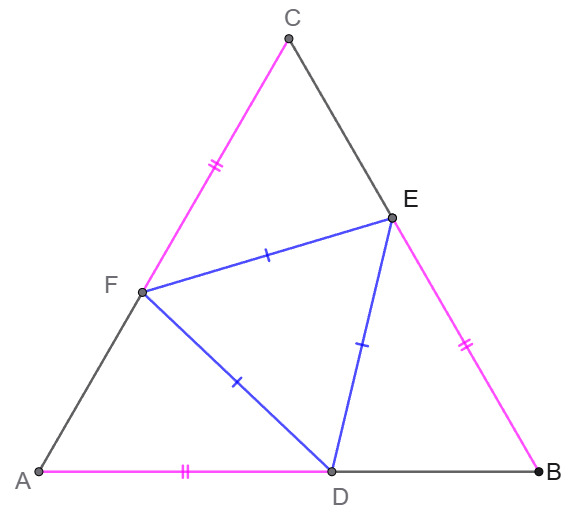
Prove (there are some issues in this proof):
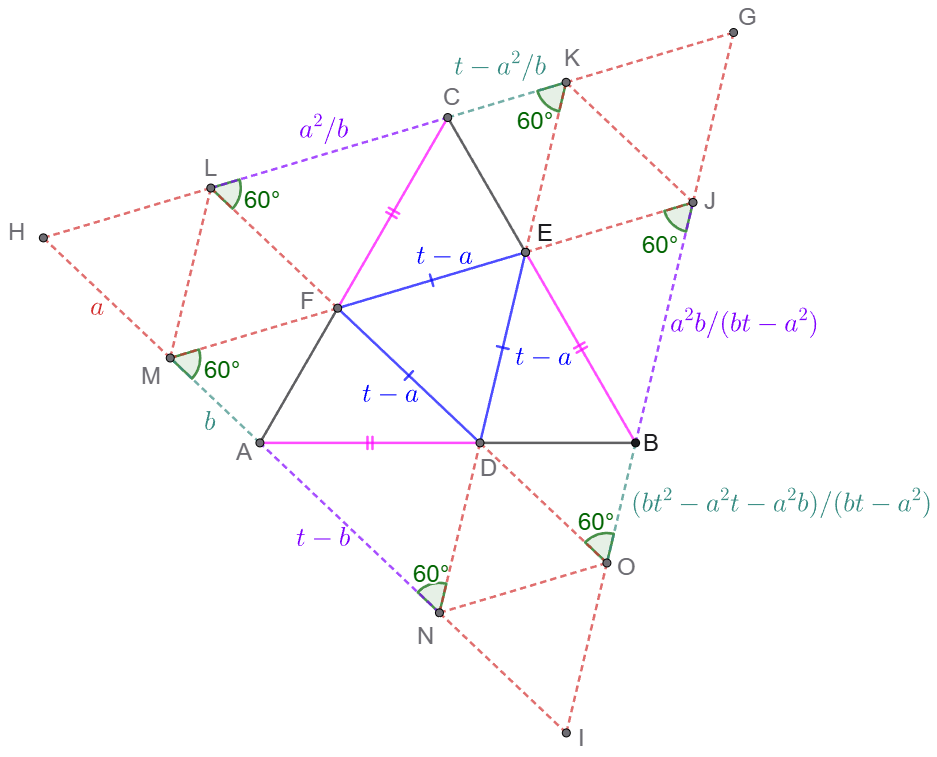 \(\begin{multline}
\shoveleft \text{Make }\triangle{GHI} \text{ such that points }A,B,C \text{ are on side }HI, IG, GH \text{ respectively}\\
\shoveleft \text{and }DE \parallel IG, EF \parallel GH, FD \parallel HI \implies \triangle{GHI} \text{ is also equilateral}\\
\shoveleft \text{Extend }DE \text{ and meet }HI, GH \text{ at }N,K\\
\shoveleft \text{Extend }EF \text{ and meet }IG, HI \text{ at }J,M\\
\shoveleft \text{Extend }FD \text{ and meet }IG, GH \text{ at }O,L\\
\shoveleft \implies \triangle{DON}, \triangle{ION}, \triangle{FML},\triangle{HML},\triangle{GKJ},\triangle{EKJ} \text{ are equilateral triangles}\\
\shoveleft \text{and their are congruent to each other, let their side length equls to }a\\
\shoveleft \implies LK=JO=MN=ME, \text{let its length be }t \implies DE=EF=FD=t-a \ne 0\\
\shoveleft \angle{AMF}=\angle{FLC}=60^\circ, \angle{MFA}=\angle{LCF}\implies \triangle{MFA}\sim\triangle{LCF}\\
\shoveleft \text{Similarly, }\triangle{CEK \sim \triangle{EBJ}, \triangle{BDO}\sim\triangle{DAN}}\\
\shoveleft \implies MA \cdot CL = a^2 = CK \cdot BJ = BO \cdot AN\\
\shoveleft \text{Let }MA=b \implies CL=\dfrac{a^2}{b} \implies CK=t-\dfrac{a^2}{b}\implies BJ=\dfrac{a^2}{CK}=\dfrac{a^2b}{bt-a^2}\\
\shoveleft \implies BO=t-BJ=\dfrac{bt^2-a^2t-a^2b}{bt-a^2}\implies AN\cdot BO=(t-b)\dfrac{bt^2-a^2t-a^2b}{bt-a^2}=a^2\\
\shoveleft \implies (a^2-t^2)(b^2-bt+a^2)=0 \implies b^2-bt+a^2=0\implies CK=t-\dfrac{a^2}{b}=b=MA\\
\shoveleft \implies \triangle{CEK}\cong\triangle{AFM}\implies CE=AF, \text{similarly, }\triangle{CEK}\cong\triangle{BDO} \implies BD=CE\\
\shoveleft \implies AF=CE=BD \implies AB=BC=CA \implies \triangle{ABC} \text{ is equilateral}\blacksquare
\end{multline}\)
Prove 2 (there are some issues in this proof too):
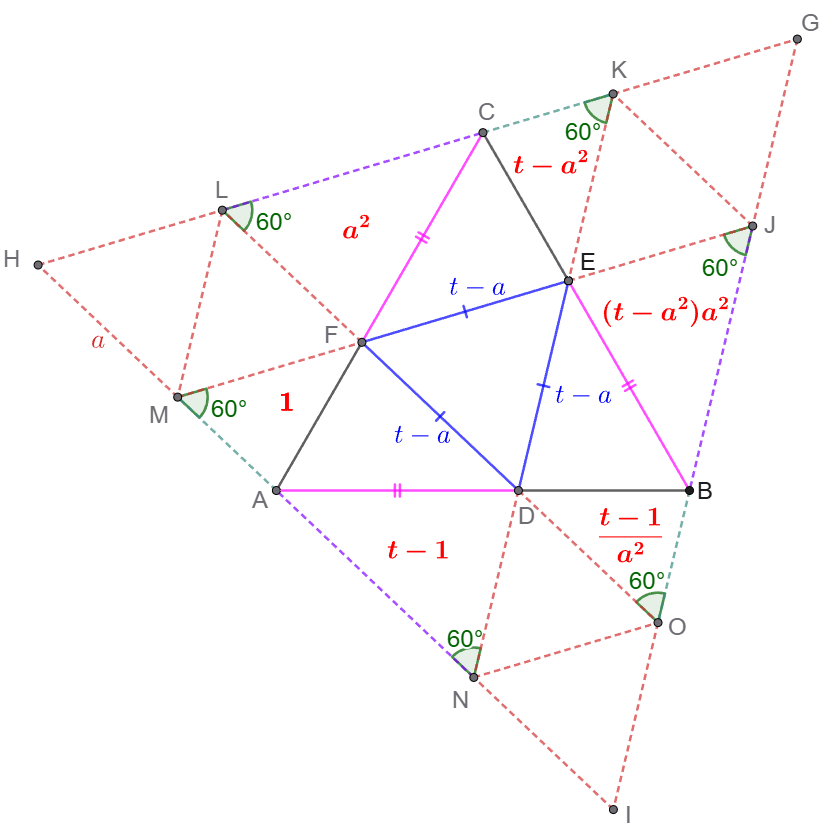 \(\begin{multline}
\shoveleft \text{Make }\triangle{GHI} \text{ such that points }A,B,C \text{ are on side }HI, IG, GH \text{ respectively}\\
\shoveleft \text{and }DE \parallel IG, EF \parallel GH, FD \parallel HI \implies \triangle{GHI} \text{ is also equilateral}\\
\shoveleft \text{Extend }DE \text{ and meet }HI, GH \text{ at }N,K\\
\shoveleft \text{Extend }EF \text{ and meet }IG, HI \text{ at }J,M\\
\shoveleft \text{Extend }FD \text{ and meet }IG, GH \text{ at }O,L\\
\shoveleft \implies \triangle{DON}, \triangle{ION}, \triangle{FML},\triangle{HML},\triangle{GKJ},\triangle{EKJ} \text{ are equilateral triangles}\\
\shoveleft \text{and their are congruent to each other, let their side length equls to }a\\
\shoveleft \implies LK=JO=MN=ME, \text{let its length be }t \implies DE=EF=FD=t-a \ne 0\\
\shoveleft \angle{AMF}=\angle{FLC}=60^\circ, \angle{MFA}=\angle{LCF}\implies \triangle{MFA}\sim\triangle{LCF}\\
\shoveleft \text{Similarly, }\triangle{CEK \sim \triangle{EBJ}, \triangle{BDO}\sim\triangle{DAN}}\\
\shoveleft \implies [CLF]=a^2[FMA], [EBJ]=a^2[CEK], [DAN]=a^2[BDO]\\
\shoveleft \implies [DAN]=(t-1)[FMA], [CEK]=(t-a^2)[FMA]\\
\shoveleft [EBJ]=(t-a^2)a^2[FMA], [BDO]=\dfrac{t-1}{a^2}[FMA]\\
\shoveleft \implies [EBJ]+[BDO]=t[FMA] \implies \dfrac{(t-a^2)}{a^2}+\dfrac{t-1}{a^2}=t\\
\shoveleft \implies t=\dfrac{a^6+1}{a^4-a^2+1}=a^2+1 \implies [CEK]=[FMA]\implies CK=AM\\
\shoveleft \implies \triangle{CEK}\cong\triangle{AFM} \implies AF=CE, \text{similarly, }\triangle{CEK}\cong\triangle{BDO} \implies BD=CE\\
\shoveleft \implies AF=CE=BD \implies AB=BC=CA \implies \triangle{ABC} \text{ is equilateral}\blacksquare
\end{multline}\)
Prove 3:
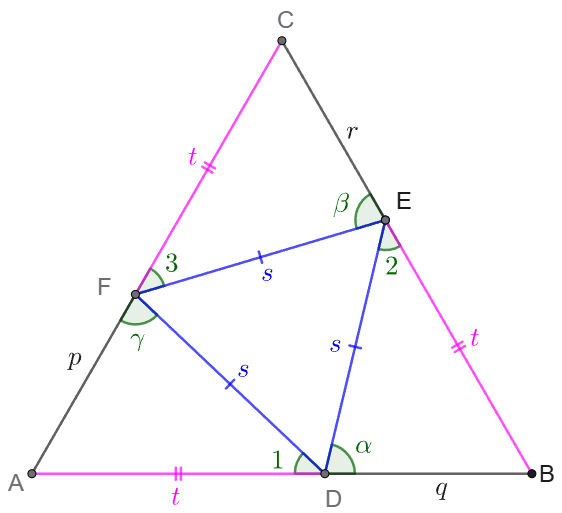 \(\begin{multline}
\shoveleft \text{Let }DE=EF=FD=s, AD=BE=CF=t, AF=p, BD=q, CE=r\\
\shoveleft \angle{AFD}=\gamma, \angle{BDE}=\alpha, \angle{CEF}=\beta, \angle{ADF}=\angle 1, \angle{BED}=\angle{2}, \angle{CFE}=\angle{3}\\
\shoveleft \implies A=60^\circ+\alpha-\gamma, B=60^\circ+\beta-\alpha, C=60^\circ+\gamma-\beta\\
\shoveleft \text{The Law of Sines: }\dfrac{sin\gamma}{sinA}=\dfrac{sin\alpha}{sinB}=\dfrac{sin\beta}{sinC}=\dfrac{t}{s}\\
\shoveleft \text{(1) If }t \le s \implies \gamma \le A, \alpha \le B, \beta \le C \implies \gamma, \alpha, \beta \le 90^\circ\\
\shoveleft \implies \gamma,\alpha, \beta \text{ have the same ordering as }A,B,C\\
\shoveleft \text{Without loss of generality, suppose }\gamma\ge \beta, \gamma \ge \alpha \implies A \ge B, A\ge C\\
\shoveleft \implies A=60^\circ+\alpha-\gamma \le 60^\circ \implies A=B=C=60^\circ\\
\shoveleft \text{(2) If }t \gt s, \text{let }AF=p, \text{ via the Law of Cosines}\\
\shoveleft \implies cos\gamma=\dfrac{s^2+p^2-t^2}{2ps}=\dfrac{1}{2s}(p-\dfrac{t^2-s^2}{p}), cos\angle{1}=\dfrac{s^2+t^2-p^2}{2st}\\
\shoveleft \implies p \uparrow \implies cos\gamma \uparrow \implies \gamma \downarrow \implies \angle{1} \uparrow \\
\shoveleft \implies p,q,r \text{ have the same ordering as }\angle{1}, \angle{2}, \angle{3}\\
\shoveleft \text{Without loss of generality, suppose }p \ge q, p \ge r\\
\shoveleft \implies \gamma \le \beta, \gamma \le \alpha \implies \angle{3} \ge \angle{2}, \angle{3} \ge \angle{1}\\
\shoveleft \implies r \ge p, r\ge q \implies \beta \le \alpha, \beta \le \gamma \implies \angle{2} \ge \angle{3}, \angle{2} \ge \angle{1}\\
\shoveleft \implies q \ge p, q\ge r \implies \alpha \ge \beta, \alpha \ge \gamma \implies \angle{1} \ge \angle{2}, \angle{1} \ge \angle{3}\\
\shoveleft \implies p=q=r\implies \triangle{ABC} \text{ is equilateral }\blacksquare
\end{multline}\)
2026/09/20
$\triangle{ABC}$ is equilateral triangle. $D$ is a point on side $BC$ and $E$ is a point on $AD$ such that $\angle{ACE}=\angle{BAD}$, $DE=2AE$, find $\angle{ADC}$
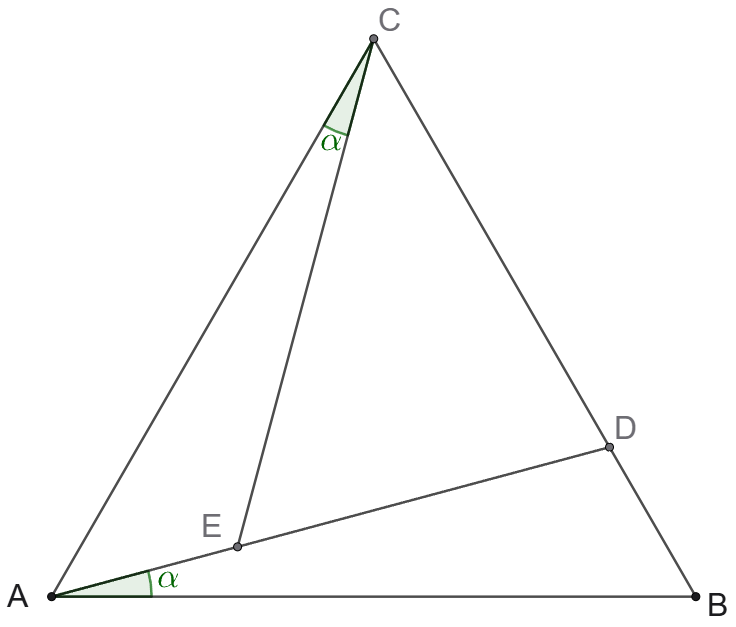
Solve:
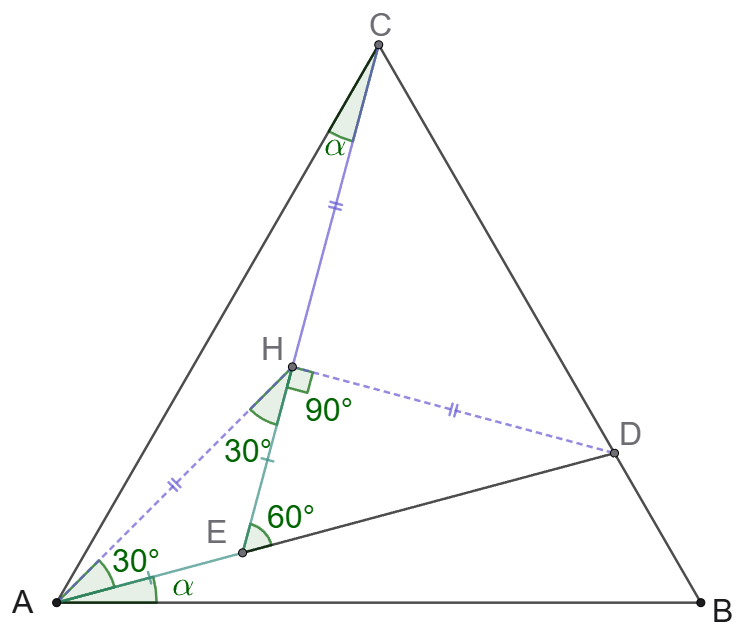 \(\begin{multline}
\shoveleft \text{Make }DH\perp CE \text{ at }H, \angle{DEC}=\angle{ACE}+\angle{CAD}=\angle{BAD}+\angle{CAD}=60^{\circ}\\
\shoveleft \implies DE=2HE=2AE\implies AE=HE\implies \angle{AHE}=\angle{HAE}=30^{\circ}=\angle{HDA}\\
\shoveleft \implies HA=HD, \angle{AHD}=120^{\circ}=2\angle{ACB}\implies H \text{ is the circumcenter of }\triangle{ACD}\\
\shoveleft \implies AH=CH \implies \angle{ACH}=\angle{CAH}=15^{\circ}\implies \angle{ADC}=180^{\circ}-60^{\circ}-45^{\circ}=\bbox[5px, border: 1px solid black]{75^\circ}
\end{multline}\)
2026/09/22
$f(f(x))=x^2-x+1$, find $f(0)$
Solve: \(\begin{multline} \shoveleft f(f(0))=1, \text{let }f(0)=m \implies f(m)=1\\ \shoveleft \implies f(f(m))=f(1)=m^2-m+1\\ \shoveleft \text{let }f(1)=n=m^2-m+1\\ \shoveleft \implies f(f(1))=f(n)=1\\ \shoveleft \implies f(f(n))=n^2-n+1=f(1)=n\\ \shoveleft \implies n^2-2n+1=0 \implies n=1\\ \shoveleft \implies f(1)=1\implies m^2-m+1=1\\ \shoveleft \implies m=0 \text{ or }m=1\\ \shoveleft m=0 \implies f(0)=0 \text{ but }f(0)=1 \implies m \ne 0\\ \shoveleft \implies m=1 \implies f(0)=\bbox[5px, border: 1px solid black]{1} \end{multline}\)
2026/09/23
$\triangle{ABC}$ is an isosceles with $\angle{ABC}=\angle{ACB}=70^{\circ}$. $D$ is inside the triangle such that $\angle{BCD}=20^{\circ}$, $\angle{CBD}=40^{\circ}$, find $\angle{CAD}$ (Note: same problem as this)
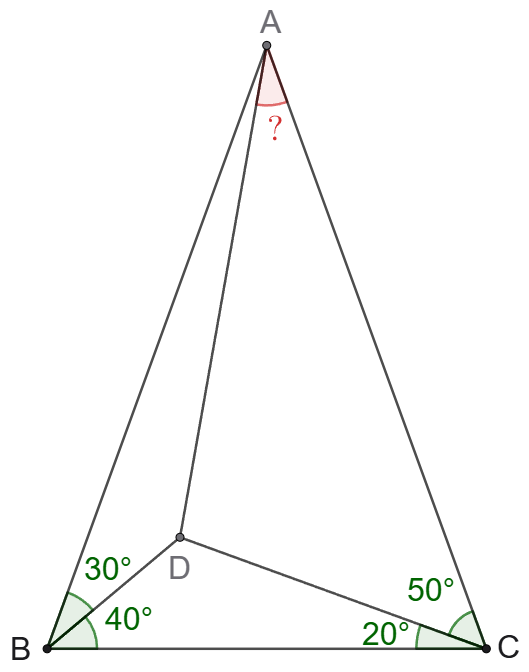
Solve 1:
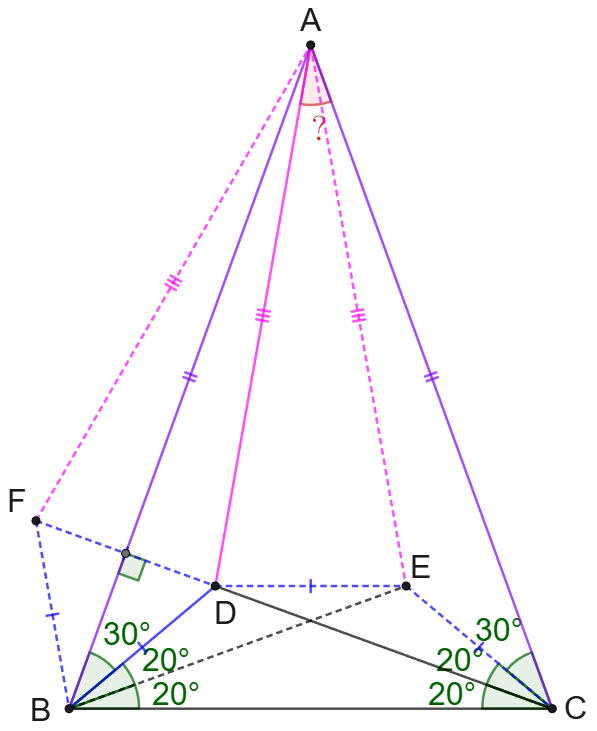 \(\begin{multline}
\shoveleft \text{Let }E \text{ be the reflection of }D \text{ about the perpendicular bisector of }BC\\
\shoveleft \implies AD=AE, DE \parallel BC, BD=CE, \angle{CBD}=\angle{BCE}=40^{\circ}, \angle{BCD}=\angle{CBE}=20^{\circ}\\
\shoveleft \implies \angle{DBE}=20^{\circ}=\angle{ECD}=\angle{BED}=\angle{CDE}\implies BD=DE=CE, \triangle{ABD}\cong\triangle{ACE}\\
\shoveleft \implies \angle{BAD}=\angle{CAE}\\
\shoveleft \text{Extend }CD \text{ to }F\text{ such that }BD=DF, AB\perp CF, \angle{BDF}=60^{\circ}\implies \triangle{BDF}\text{ is equilateral}\\
\shoveleft \implies BF=BD=DF=DE, \triangle{ABF}\cong\triangle{ABD}\implies \angle{FAB}=\angle{DAB},AD=AF\\
\shoveleft \implies \triangle{ADF}\cong\triangle{ADE}\implies \angle{FAD}=\angle{DAE}\implies \angle{BAD}=\dfrac{\angle{BAC}}{4}=10^{\circ}\implies \angle{CAD}=\bbox[5px, border: 1px solid black]{30^{\circ}}
\end{multline}\)
—