2022/09/09
There are 30 ant nests located on a straight line with equal distance between two adjacent nests. And there are 100 ants in the first nest, 200 ants in the second nest, 300 ants in the third nest, … 3000 ants in the 30th nest. Now all the ants need walk to one nest. They should walk to which nest in order to get the minimal sum of walk distances of all the ants?
Solve 1:
Suppose the ants should walk to the $k^{th}$ nest in order to get the minimal sum of walk distances of all ants. Let $S_{k}$ be the sum of walk distances of all ants to the $k^{th}$ nest. Then we know $S_{k-1} - S_{k} > 0$ and $S_{k+1} - S_{k} > 0$.
Assume $d$ is the distance between two adjacent nests. Let’s check $S_{k-1} - S_{k}$. For ants in the 1st nest to $(k-2)^{th}$ nest, they originally walk to $k^{th}$ nest, but now they need walk to $(k-1)^{th}$ nest, so the walk distance it saves is $[100 + 200 + … + (k-2)] \times 100 \times d$. The ants in $(k-1)^{th}$ nest originally walks to $k^{th}$ nest, now they stay in, so it saves $(k-1) \times 100 \times d$. The ants in $k^{th}$ nest originally stay in, but now they walk to $(k-1)^{th}$ nest, so it increases $k \times 100 \times d$. The ants in $(k+1)^{th}$ nest to $30^{th}$ nest originally walk to $k^{th}$ nest, now they walk to $(k-1)^{th}$ nest, so it increases $[(k+1) \times 100 + (k+2) \times 100 + … + 30 \times 100] \times d$. \(\begin{multline} \shoveleft S_{k-1} - S_{k} > 0 \implies \\ \nonumber \shoveleft -(1+2+...+(k-2)) \times 100 \times d-(k-1) \times 100 \times d+k \times 100 \times d+((k+1)+(k+2)+...+30) \times 100 \times d>0 \\ \shoveleft \implies -[1 + 2 + ... + (k-2) + (k-1)] + [k + (k+1) + ... + 30] > 0\\ \shoveleft \implies \dfrac{30 \times 31}{2}-2\dfrac{(k-1)k}{2}>0\\ \shoveleft \implies k(k-1) < 31 \times 15 = 465 \quad \text{(1)}\\ \end{multline}\)
Similarly, let’s check $S_{k+1} - S_{k}$. For ants in the 1st nest to 1st nest to $(k-1)^{th}$ nest, they originally walk to $k^{th}$ nest, but now they need walk to $(k+1)^{th}$ nest, so the walk distance it increases is $[100 + 200 + … + (k-1) \times 100] \times d$. The ants in $k^{th}$ nest originally stay in the same nest, now they need to walk to $(k+1)^{th}$ nest, so it increases $k \times 100 \times d$. The ants in $(k+1)^{th}$ nest originally walk to $k^{th}$ nest, but now they stay in, so it saves $(k+1) \times 100 \times d$. The ants in $(k+2)^{th}$ nest to $30^{th}$ nest originally walk to $k^{th}$ nest but now they walk to $(k+1)^{th}$ nest, so it saves $[(k+2) \times 100 + (k+3) \times 100 + … + 30 \times 100] \times d$. \(\begin{multline}\nonumber \shoveleft S_{k+1}-S_{k}\gt 0\implies \\ \shoveleft (1+2+...+(k-1)) \times 100 \times d+k \times 100 \times d-(k+1) \times 100 \times d-((k+2)+(k+3)+...+30) \times 100 \times d>0\\ \shoveleft \implies [1+2+...+(k-1)+k]-[(k+1)+(k+2)+(k+3)+...+30]>0\\ \shoveleft \implies -\dfrac{30 \times 31}{2}+2\dfrac{k(k+1)}{2} > 0\\ \shoveleft \implies k(k+1) > 31 \times 15 = 465 \quad \text{(2)}\\ \end{multline}\)
$21 \times 22=441<465, 22 \times 23=506>465 \implies k=\boxed{22}$
Solve 2:
The required value of $k$ makes the closest difference of the sum of ants on its left side and the sum of ants on its right side. This means to get minimal value of following expression:
$\lvert \dfrac{k(k-1)}{2}-[\dfrac{30*31}{2}-\dfrac{k(k+1)}{2}]\rvert =\lvert \dfrac{k(k-1)}{2}+\dfrac{k(k+1)}{2}-465 \rvert=\lvert k^2-465 \rvert$
Easy to see that it gets minimal value when $k=\boxed{22}$.
2022/09/14
Suppose $I$ is the incenter of $\triangle{ABC}$ and $AI=d, BI=e, CI=f$. Find the perimeter and area of $\triangle{ABC}$.
Solve: \(\begin{multline} \nonumber \shoveleft \text{Let } P_{\triangle{ABC}}=a+b+c, M=\dfrac{2abc}{a+b+c} \implies abc=\dfrac{M(a+b+c)}{2}=\dfrac{MP_{\triangle{ABC}}}{2} \quad \text{(0)}\\ \shoveleft \text{Use Barycentric coordinates: } I(\dfrac{a}{a+b+c},\dfrac{b}{a+b+c},\dfrac{c}{a+b+c}), A(1,0,0),B(0,1,0),C(0,0,1)\\ \shoveleft \text{For displacement vector }\overrightarrow{PQ}=(x,y,z), |PQ|^2=-a^2yz-b^2zx-c^2xy \text{. Thus we have:}\\ \shoveleft d^2=\dfrac{bc(b+c-a)}{a+b+c}=bc-\dfrac{2abc}{a+b+c}=bc-M \implies b+c-a=\dfrac{d^2(a+b+c)}{bc}, bc=d^2+M \quad \text{(1)}\\ \shoveleft e^2=\dfrac{ca(c+a-b)}{a+b+c}=ca-\dfrac{2abc}{a+b+c}=ca-M \implies c+a-b=\dfrac{e^2(a+b+c)}{ca}, ca=e^2+M \quad \text{(2)}\\ \shoveleft f^2=\dfrac{ab(a+b-c)}{a+b+c}=ab-\dfrac{2abc}{a+b+c}=ab-M \implies a+b-c=\dfrac{f^2(a+b+c)}{ab}, ab=f^2+M \quad \text{(3)}\\ \shoveleft \sqrt{(1)*(2)*(3)} \implies abc=\sqrt{(d^2+M)(e^2+M)(f^2+M)}\\ \shoveleft \sqrt{(1)*(2)*(3)}/(1,2,3) \implies a=\dfrac{\sqrt{(e^2+M)(f^2+M)}}{\sqrt{d^2+M}},b=\dfrac{\sqrt{(f^2+M)(d^2+M)}}{\sqrt{e^2+M}},c=\dfrac{\sqrt{(d^2+M)(e^2+M)}}{\sqrt{f^2+M}}\\ \shoveleft (0) \implies M=\dfrac{2\sqrt{(d^2+M)(e^2+M)(f^2+M)}}{\dfrac{\sqrt{(e^2+M)(f^2+M)}}{\sqrt{d^2+M}}+\dfrac{\sqrt{(f^2+M)(d^2+M)}}{\sqrt{e^2+M}}+\dfrac{\sqrt{(d^2+M)(e^2+M)}}{\sqrt{f^2+M}}}\\ \shoveleft \implies M^3-(d^2e^2+e^2f^2+f^2d^2)M-2d^2e^2f^2=0 \text{, solve this cubic equation about }M:\\ \shoveleft \text{Let } B=\dfrac{d^2e^2+e^2f^2+f^2d^2}{3}, A=(\sqrt{d^4e^4f^4-B^3}+d^2e^2f^2)^{\tfrac{1}{3}} \implies M=\dfrac{B}{A} + A\\ \shoveleft P_{\triangle{ABC}}=a+b+c=\bbox[5px, border: 1px solid black]{\dfrac{2abc}{M}=\dfrac{2\sqrt{(d^2+M)(e^2+M)(f^2+M)}}{M}}\\ \shoveleft S_{\triangle{ABC}}=\sqrt{\dfrac{(a+b+c)(a+b-c)(b+c-a)(c+a-b)}{2^4}}=\dfrac{def(a+b+c)^2}{4abc}=\dfrac{abcdef}{M^2}=\bbox[5px, border: 1px solid black]{\dfrac{defP_{\triangle{ABC}}}{2M}} \\ \end{multline}\)
2022/09/16
Compute $\frac{\sqrt{10+\sqrt{1}}+\sqrt{10+\sqrt{2}}+\sqrt{10+\sqrt{3}}+\cdots +\sqrt{10+\sqrt{99}}}{\sqrt{10-\sqrt{1}}+\sqrt{10-\sqrt{2}}+\sqrt{10-\sqrt{3}}+ \cdots +\sqrt{10-\sqrt{99}}}$
Solve: \(\begin{multline}\nonumber \shoveleft \text{Let }\displaystyle A=\sum_{k=1}^{n^2-1}{\sqrt{n+\sqrt{k}}}, B=\sum_{k=1}^{n^2-1}{\sqrt{n-\sqrt{k}}}\\ \shoveleft A-B=\sum_{k=1}^{n^2-1}{(\sqrt{n+\sqrt{k}}-\sqrt{n-\sqrt{k}})}\\ \shoveleft \Bigl(\sqrt{n+\sqrt{k}}-\sqrt{n-\sqrt{k}}\Bigr)^2=2(n-\sqrt{n^2-k})\\ \shoveleft \implies \sqrt{n+\sqrt{k}}-\sqrt{n-\sqrt{k}}=\sqrt{2}\sqrt{n-\sqrt{n^2-k}}\\ \shoveleft \implies \sum_{k=1}^{n^2-1}{\Bigl(\sqrt{n+\sqrt{k}}-\sqrt{n-\sqrt{k}}\Bigr)}=\sqrt{2}\sum_{k=1}^{n^2-1}{\sqrt{n-\sqrt{n^2-k}}}\\ \shoveleft \text{Let } i=n^2-k \implies \sum_{k=1}^{n^2-1}{\sqrt{n-\sqrt{n^2-k}}}=\sum_{i=1}^{n^2-1}{\sqrt{n-\sqrt{i}}}=\sum_{k=1}^{n^2-1}{\sqrt{n-\sqrt{k}}}=B\\ \shoveleft \implies A-B=\sqrt{2}\cdot B\implies \cfrac{A}{B}=\bbox[5px, border: 1px solid black]{\sqrt{2}+1} \end{multline}\)
2022/09/26
Find the angle:
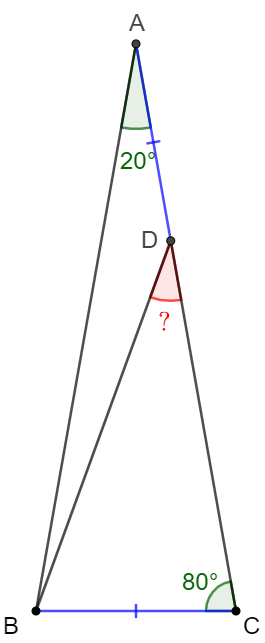
Solve 1:
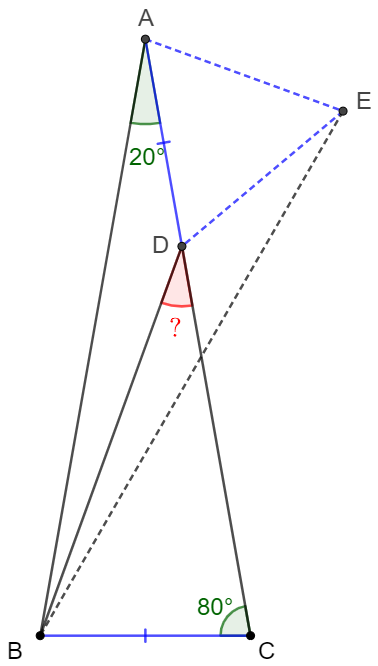 \(\begin{multline}\nonumber
\shoveleft \text{Easy to see that } AB=AC. \text{ Make equilateral triangle } \triangle{ADE}\\
\shoveleft \text{Easy to see that } \angle{ABC}=\angle{BAE}=80^{\circ}, BC=AD=AE\\
\shoveleft \implies \triangle{ABC} \cong \triangle{BAE} \implies AB=AC=BE, \angle{ABE}=\angle{BAC}=20^{\circ} \\
\shoveleft \text{and since } AD=DE \implies \triangle{ABD} \cong \triangle{EBD} \\
\shoveleft \implies \angle{ABD}=\angle{EBD}=\cfrac{\angle{ABE}}{2}=10^{\circ}\\
\shoveleft \implies \angle{BDC}=\angle{ABD}+\angle{BAC}=\bbox[5px, border: 1px solid black]{30^{\circ}}
\end{multline}\)
\(\begin{multline}\nonumber
\shoveleft \text{Easy to see that } AB=AC. \text{ Make equilateral triangle } \triangle{ADE}\\
\shoveleft \text{Easy to see that } \angle{ABC}=\angle{BAE}=80^{\circ}, BC=AD=AE\\
\shoveleft \implies \triangle{ABC} \cong \triangle{BAE} \implies AB=AC=BE, \angle{ABE}=\angle{BAC}=20^{\circ} \\
\shoveleft \text{and since } AD=DE \implies \triangle{ABD} \cong \triangle{EBD} \\
\shoveleft \implies \angle{ABD}=\angle{EBD}=\cfrac{\angle{ABE}}{2}=10^{\circ}\\
\shoveleft \implies \angle{BDC}=\angle{ABD}+\angle{BAC}=\bbox[5px, border: 1px solid black]{30^{\circ}}
\end{multline}\)
Solve 2:
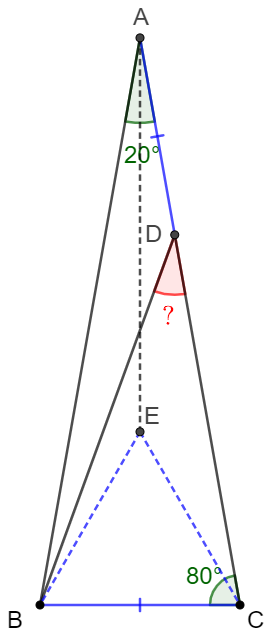 \(\begin{multline}\nonumber
\shoveleft \text{ Easy to see that } AB=AC. \text{ Make equilateral triangle } \triangle{BCE}\\
\shoveleft AB=AC, BE=CE \implies \triangle{BAE} \cong \triangle{CAE}\\
\shoveleft \implies \angle{BAE}=\angle{CAE}=\cfrac{\angle{BAC}}{2}=10^{\circ}\\
\shoveleft \text{ Also easy to see that } \angle{BAC}=\angle{ABE}=20^{\circ}, BC=AD=BE\\
\shoveleft \implies \triangle{ABE} \cong \triangle{BAD} \implies \angle{ABD}=\angle{BAE}=10^{\circ} \\
\shoveleft \implies \angle{BDC}=\angle{ABD}+\angle{BAC}=\bbox[5px, border: 1px solid black]{30^{\circ}}
\end{multline}\)
\(\begin{multline}\nonumber
\shoveleft \text{ Easy to see that } AB=AC. \text{ Make equilateral triangle } \triangle{BCE}\\
\shoveleft AB=AC, BE=CE \implies \triangle{BAE} \cong \triangle{CAE}\\
\shoveleft \implies \angle{BAE}=\angle{CAE}=\cfrac{\angle{BAC}}{2}=10^{\circ}\\
\shoveleft \text{ Also easy to see that } \angle{BAC}=\angle{ABE}=20^{\circ}, BC=AD=BE\\
\shoveleft \implies \triangle{ABE} \cong \triangle{BAD} \implies \angle{ABD}=\angle{BAE}=10^{\circ} \\
\shoveleft \implies \angle{BDC}=\angle{ABD}+\angle{BAC}=\bbox[5px, border: 1px solid black]{30^{\circ}}
\end{multline}\)
2022/09/27
Let the inscribed circle of the $\triangle{ABC}$ touch side $BC$ at $D$, side $CA$ at $E$, and side $AB$ at $F$. Let $G$ be a point from $[EF]$ such that $\cfrac{FG}{EG}=\cfrac{BG}{CG}$. Show that $DG \perp EF$
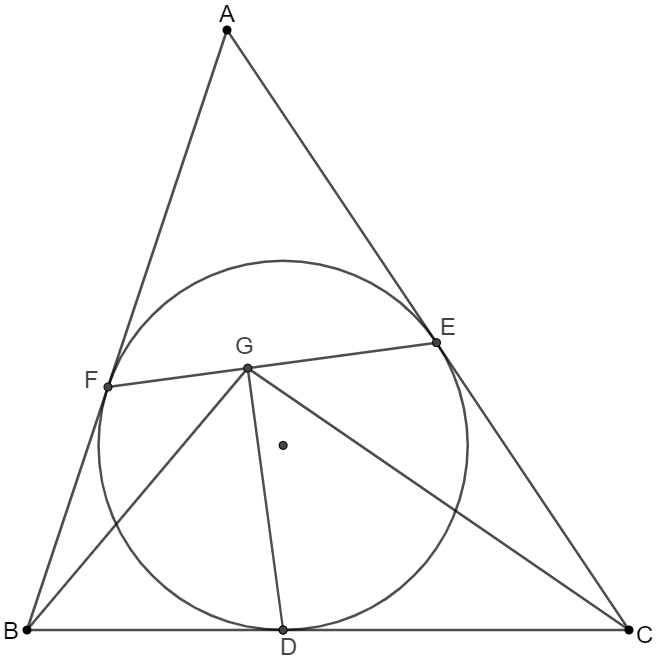
Prove: \(\begin{multline}\nonumber \shoveleft \text{By the law of sines: }\cfrac{FG}{BG}=\cfrac{sin\angle{FBG}}{sin\angle{BFG}}=\cfrac{EG}{CG}=\cfrac{sin\angle{ECG}}{sin\angle{CEG}}\\ \shoveleft \text{And we know } \angle{BFG}=\angle{CEG} \implies sin{\angle{FBG}}=sin\angle{ECG}\\ \shoveleft \text{And we know }\angle{FBG} < 90^{\circ}, \angle{ECG} < 90^{\circ} \implies \angle{FBG}=\angle{ECG}\\ \shoveleft \implies {\angle{FGB}=\angle{EGC}} \implies \triangle{BFG} \sim \triangle{ECG} \\ \shoveleft \implies \cfrac{FG}{EG}=\cfrac{BF}{CE}=\cfrac{BD}{CD}=\cfrac{BG}{CG} \implies \angle{BGD}=\angle{DGC} \\ \shoveleft \implies \angle{FGB}+\angle{BGD}=\cfrac{180^{\circ}}{2}=90^{\circ} \implies DG \perp EF \blacksquare \end{multline}\)
2022/09/28
Find $\angle{CDE}$ in following figure:
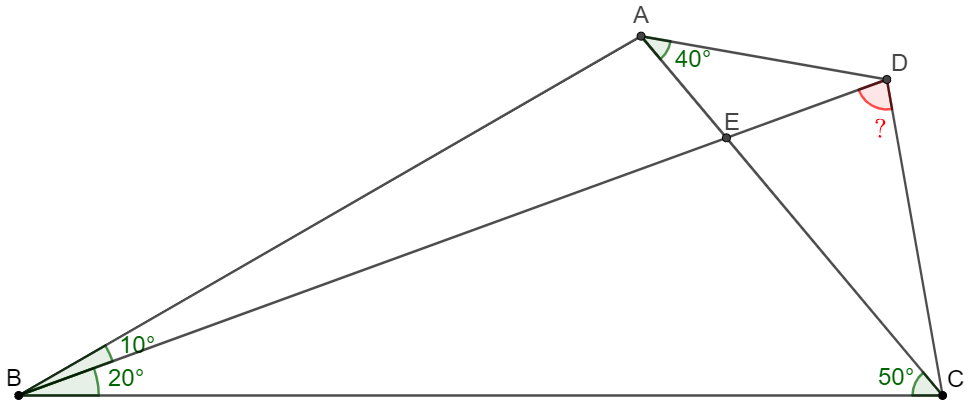
Solve 1:
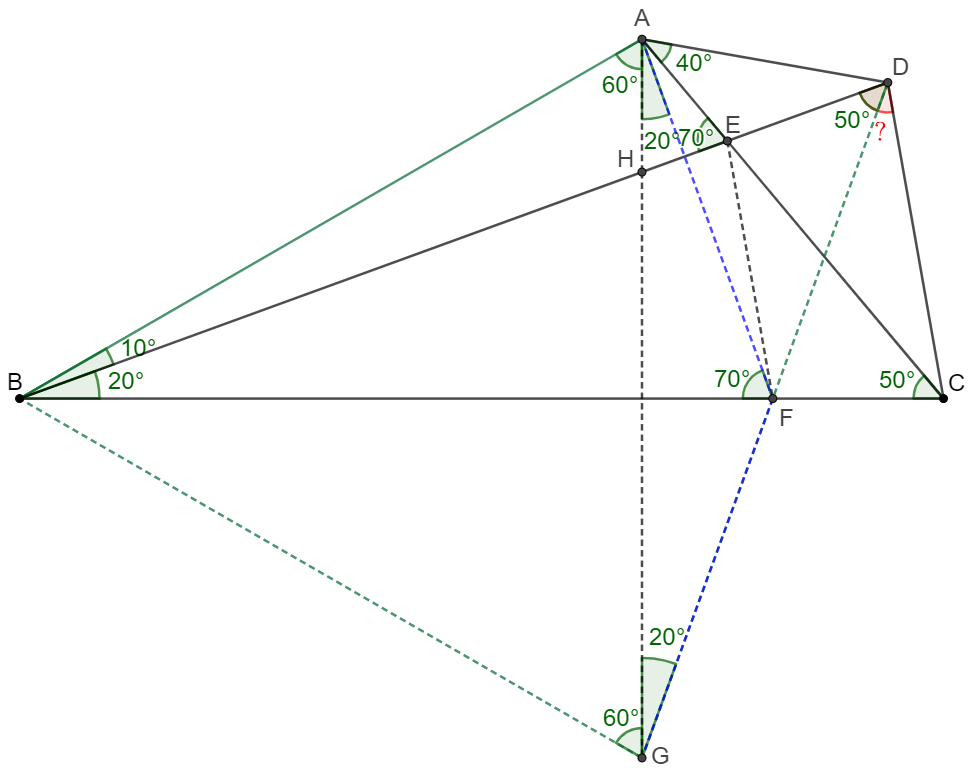 .
\(\begin{multline}\nonumber
\shoveleft \text {Easy to see } \angle{BAC}=100^{\circ}, \angle{AEB}=70^{\circ},\angle{ADB}=30^{\circ}\\
\shoveleft \text{Make equilateral } \triangle{ABG}, \text{let } DG \text{ and } BC \text{ intersect at }F. \text{Connect }AF, EF\\
\shoveleft \implies AG=BG, \angle{AGB}=60^{\circ}=2\angle{ADB} \implies G \text{ is circumcenter of } \triangle{ABD}\\
\shoveleft BF \perp AG, \angle{GAF}=\angle{AGD}=20^{\circ} \implies \angle{AFB}=70^{\circ}=\angle{AEB}\\
\shoveleft \implies AEFB \text { are cyclic } \implies \angle{EFB}=180^{\circ}-\angle{BAC}=80^{\circ}\\
\shoveleft G \text{ is the circumcenter of } \triangle{ABD} \implies AG=DG=AB\\
\shoveleft \implies \angle{BDG}=\angle{DBG}=\cfrac{180^{\circ}-\angle{DGB}}{2}=50^{\circ}=\angle{ACB}\\
\shoveleft \implies CDEF \text{ are cyclic } \implies \angle{CDE}=\angle{EFB}=\bbox[5px, border: 1px solid black]{80^{\circ}}\\
\end{multline}\)
.
\(\begin{multline}\nonumber
\shoveleft \text {Easy to see } \angle{BAC}=100^{\circ}, \angle{AEB}=70^{\circ},\angle{ADB}=30^{\circ}\\
\shoveleft \text{Make equilateral } \triangle{ABG}, \text{let } DG \text{ and } BC \text{ intersect at }F. \text{Connect }AF, EF\\
\shoveleft \implies AG=BG, \angle{AGB}=60^{\circ}=2\angle{ADB} \implies G \text{ is circumcenter of } \triangle{ABD}\\
\shoveleft BF \perp AG, \angle{GAF}=\angle{AGD}=20^{\circ} \implies \angle{AFB}=70^{\circ}=\angle{AEB}\\
\shoveleft \implies AEFB \text { are cyclic } \implies \angle{EFB}=180^{\circ}-\angle{BAC}=80^{\circ}\\
\shoveleft G \text{ is the circumcenter of } \triangle{ABD} \implies AG=DG=AB\\
\shoveleft \implies \angle{BDG}=\angle{DBG}=\cfrac{180^{\circ}-\angle{DGB}}{2}=50^{\circ}=\angle{ACB}\\
\shoveleft \implies CDEF \text{ are cyclic } \implies \angle{CDE}=\angle{EFB}=\bbox[5px, border: 1px solid black]{80^{\circ}}\\
\end{multline}\)
Solve 2:
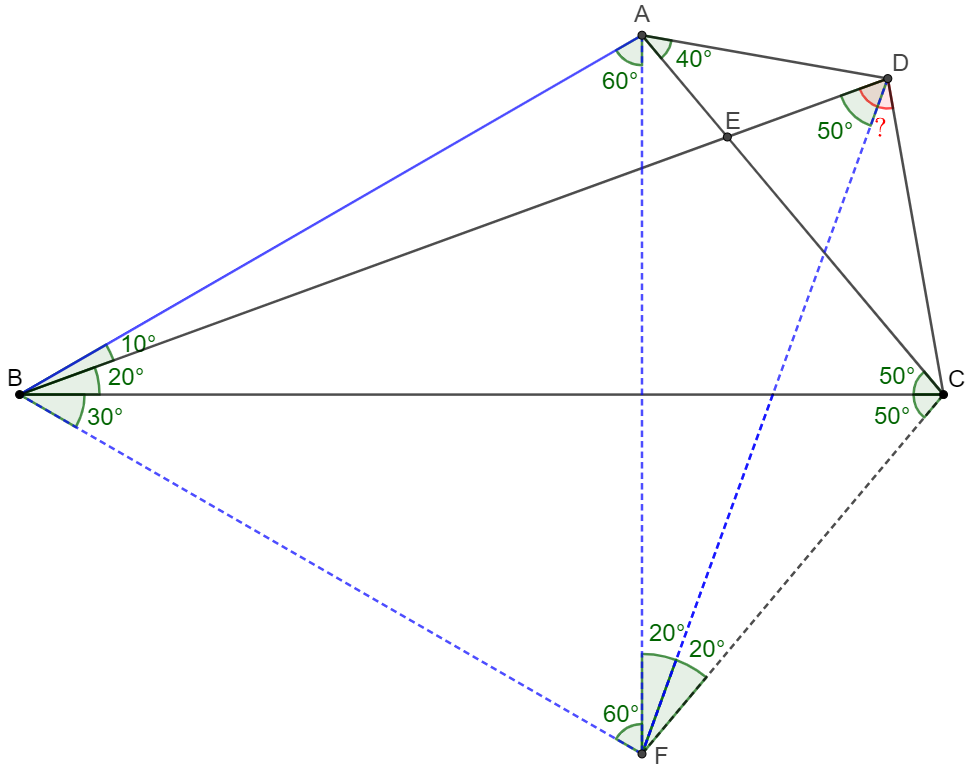
. \(\begin{multline}\nonumber \shoveleft \text {Easy to see } \angle{ADB}=30^{\circ}. \text{Let }F \text{ be the reflected point of }A \text{ over }BC, \text{Connect }CF, DF\\ \shoveleft \implies \angle{BCF}=\angle{ACB}=50^{\circ},AB=BF,\angle{CBF}=30^{\circ} \implies \angle{ABF}=60^{\circ}\\ \shoveleft \implies \triangle{ABF} \text{ is equilateral} \implies AF=BF, \angle{AFB}=60^{\circ}=2\angle{ADB}\\ \shoveleft \implies F \text{ is circumcenter of } \triangle{ABD} \implies \angle{AFD}=2\angle{ABD}=20^{\circ},AF=BF=DF\\ \shoveleft \implies \angle{BDF}=\angle{DBF}=50^{\circ}=\angle{BCF} \implies BDCF \text { are cyclic }\\ \shoveleft \implies \angle{CFD}=\angle{CBD}=20^{\circ}, \angle{CDB}=180^{\circ}-\angle{CFB}=180^{\circ}-100^{\circ}=\bbox[5px, border: 1px solid black]{80^{\circ}}\\ \end{multline}\)
Solve 3:
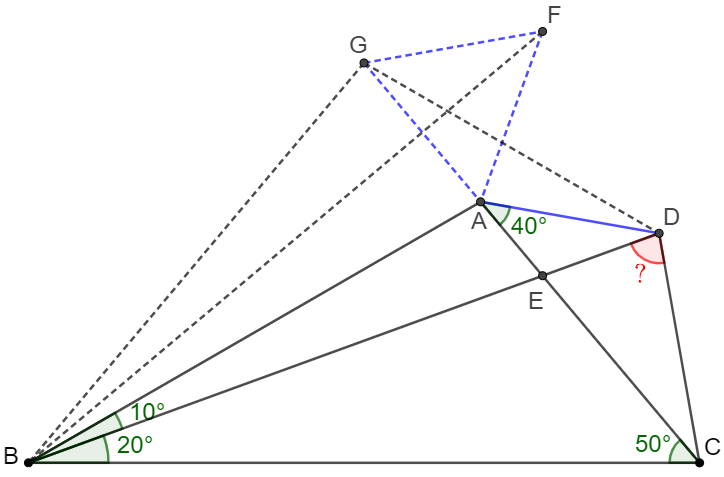
. \(\begin{multline}\nonumber \shoveleft \text{ Suppose reflect }D \text{ over }AB \text{ and get }F, \text{ reflect }A\text{ over }BF \text{ and get }G\\ \shoveleft \text {Easy to see } \angle{BAC}=100^{\circ}, AB=AG, \angle{ABG}=20^{\circ}\\ \shoveleft \implies \angle{BAG}=\angle{BGA}=80^{\circ} \implies C,A,G \text{ are collinear}\\ \shoveleft \text{And } AD=AF=FG, \angle{ADB}=30^{\circ}, \angle{BFA}=\angle{BFG}=\angle{ADB}=30^{\circ}\\ \shoveleft \implies \triangle{AFG} \text{ is equilateral} \implies AD=AG \implies \angle{ADG}=\angle{AGD}=20^{\circ}=\angle{CBD}\\ \shoveleft \implies BCDG \text{ are cyclic} \implies \angle{CDB}=\angle{CGB}=\bbox[5px, border: 1px solid black]{80^{\circ}}\\ \end{multline}\)
Solve 4:
The problem can be generalized to following figure:
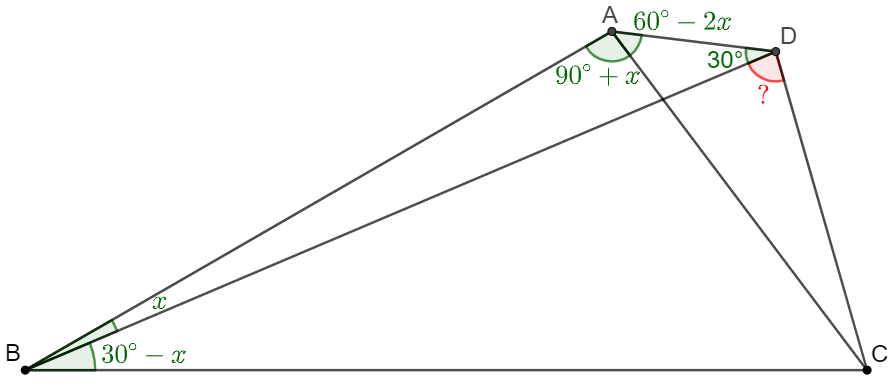
Let $O$ be the reflection point of $A$ over line $BC$. Connect $CO, DO$.
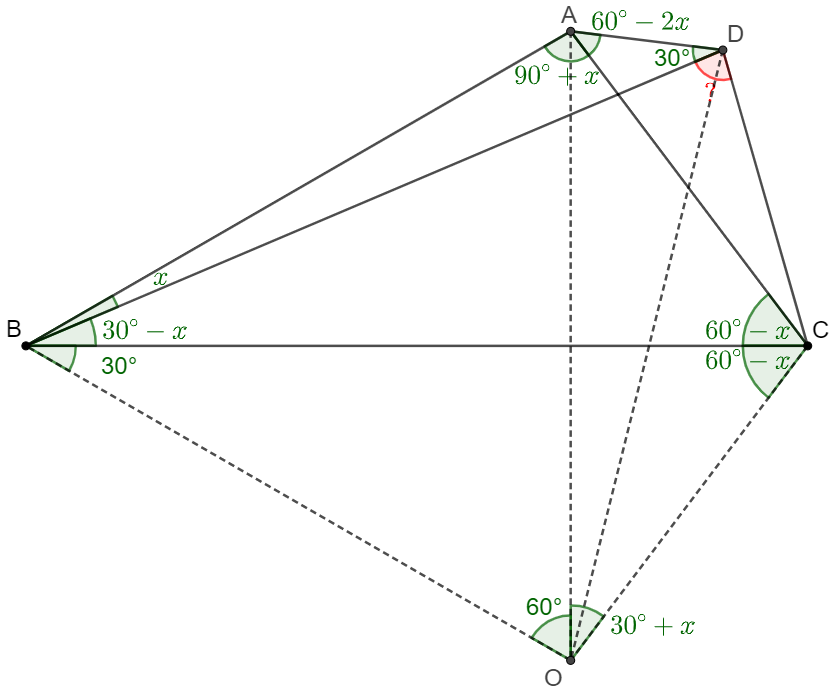
. \(\begin{multline} \nonumber \shoveleft \text{Easy to see that } \angle{BO=AB}, \angle{CBO}=\angle{ABO}=30^{\circ} \implies \triangle{ABO} \text{ is equilateral}\\ \shoveleft \implies \triangle{ABC} \cong \triangle{OBC} \implies \angle{OCB}=\angle{ACB}=60^{\circ}-x, \angle{BOC}=\angle{BAC}=90^{\circ}+x\\ \shoveleft \implies AO=BO, \angle{AOB}=60^{\circ}=2\angle{ADB} \implies O \text{ is circumcenter of } \triangle{ABD} \\ \shoveleft \implies AO=DO=BO \implies \angle{BDO}=\angle{DBO}=60^{\circ}-x = \angle{OCB}\\ \shoveleft \implies BDCO \text{ are cyclic} \implies \angle{BDC}=180^{\circ}-\angle{BOC}=180^{\circ}-90^{\circ}-x=\bbox[5px, border: 1px solid black]{90^{\circ}-x}\\ \shoveleft \text{When } x=10^{\circ}, \angle{BDC}=\bbox[5px, border: 1px solid black]{80^{\circ}}\\ \end{multline}\)